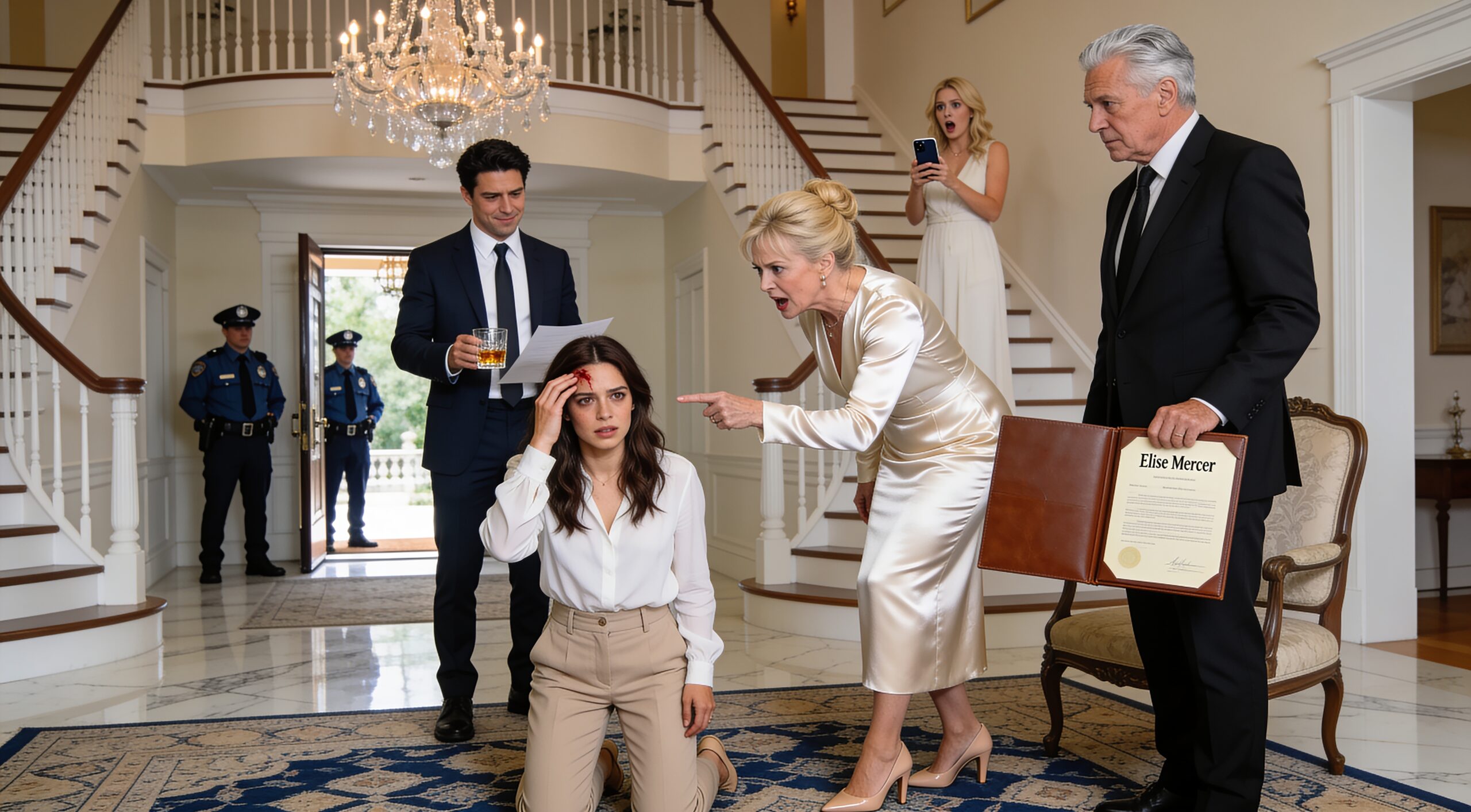
The first thing I remember after Victoria hit me was the chandelier.
It was upside down.
At least, that was how it looked from the rug.
One second I had been standing in the center of the Mercer foyer, trying to keep my voice steady while Victoria told me I had no right to enter the house. The next, my shoulder struck the floor, my palm slid across the patterned rug, and the enormous crystal chandelier above us seemed to tilt sideways.
Then I felt the warmth running past my left eyebrow.
I touched my forehead.
When I looked at my fingers, there was blood.
Nobody moved.
That was the part I would remember later more clearly than the slap itself.
Grant was standing only a few feet away.
My husband.
Or, by that point, the man I was still legally married to but no longer recognized.
He held a short glass of amber liquor in one hand. His navy suit was perfectly pressed. His expression was not.
For half a second, I saw something at the corner of his mouth that looked almost like a smile.
Maybe it was disbelief.
Maybe it was nerves.
Maybe I needed it to be something other than amusement.
But in that moment, sitting on the floor with his mother above me, it felt like betrayal.
Victoria looked down as if she had finally accomplished something she had been trying to do for months.
“Now leave,” she said.
Her ivory satin dress barely moved when she spoke. Her hair was pinned neatly into the same formal twist she wore whenever the Mercer family gathered for anything important. If you had entered the room after the slap, you might have thought she was the calmest person there.
She was not.
She had been angry before I arrived.
I could hear it in the messages she sent that morning.
Do not come here.
Your things will be boxed.
You are no longer welcome in this house.
Grant and I had been separated for seven weeks.
Not divorced.
Not reconciled.
Suspended somewhere in the miserable middle, where every conversation became a negotiation and every silence meant someone was avoiding the truth.
The mansion was one of those truths.
For most of our marriage, I never thought of it as mine.
I never wanted to.
The Mercer house had existed before me, with its double staircase, chandeliers, formal sitting rooms, polished stone tables, and generations of family photographs arranged as if nothing painful had ever happened beneath that roof.
When I married Grant, Victoria made sure I understood that I was entering a family with history.
What she really meant was hierarchy.
There were ways things were done.
There were people who were asked.
There were people who were told.
And there were people, like me, who were expected to be grateful for being included.
For years, I tried.
I went to the dinners.
I smiled through Victoria correcting the way I hosted holidays.
I sat quietly when she rearranged rooms I had just finished setting up because, as she put it, “This house has always looked a certain way.”
Grant told me to ignore it.
“That’s just Mom,” he would say.
Eventually I realized that sentence had become the answer to everything.
Why did she enter our bedroom without knocking?
That’s just Mom.
Why did she tell the staff to call her before making changes I requested?
That’s just Mom.
Why did she open mail addressed to both Grant and me?
That’s just Mom.
Why did she repeatedly tell people the house would “return to the family” if our marriage failed?
That’s just Mom.
The difference was that six months before our separation, I had accidentally learned that the legal reality of the mansion did not match Victoria’s version.
I found out because of a water-damage repair.
A pipe had burst behind a wall in one of the upstairs rooms. The insurance company needed title information before authorizing part of the work. Grant was traveling. Victoria was out of town.
Mr. Avery came to the house.
He was a silver-haired man in his late sixties who had managed property paperwork for the Mercer family longer than I had known Grant.
He carried the same brown leather folder I saw in the foyer the night Victoria hit me.
That afternoon, months earlier, he had opened the file, searched for a document, and then stopped.
“What?” I asked.
He looked at me for a long moment.
“Elise, has anyone explained the current deed structure to you?”
I laughed because I thought it was a strange question.
“No. Why would they?”
He did not answer right away.
Instead, he turned the file slightly so I could see my own name.
Elise Mercer.
I remember staring at it.
I asked if it was a clerical error.
He said it was not.
Years earlier, when the property had been restructured, control of the residence had been placed into a deed arrangement that named me directly after Grant and I married. The exact family reasons were complicated, but the practical point was not.
My name mattered.
I had rights to the property Victoria had always described as belonging exclusively to her side of the family.
I asked Grant about it that night.
He looked surprised.
Then uncomfortable.
Then irritated.
“Why were you digging through property papers?”
“I wasn’t,” I said. “Mr. Avery showed me.”
Grant rubbed his forehead.
“It’s paperwork, Elise.”
“It’s my name on a deed.”
“It doesn’t change anything.”
I wish I had understood then how much that sentence would change.
Over the following months, the tension between us grew.
The mansion was not the only reason.
It was simply the clearest example of the problem.
Grant had spent his whole life allowing Victoria to decide what counted as important.
If she said a boundary did not matter, he acted as if it did not.
If she said I was being dramatic, he repeated the word later.
If she said something was “family business,” suddenly I was not family.
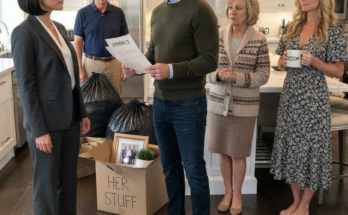
When Grant and I separated, I moved temporarily into a furnished apartment across town.
I took clothes, my laptop, a few boxes, and almost nothing else.
I told him I needed space.
I did not surrender the house.
Victoria decided I had.
Within two weeks, the locks were changed.
The first time my key failed, I thought the mechanism was broken.
Then one of the household staff quietly told me Victoria had ordered new access codes.
I called Grant.
He sighed before I finished explaining.
“Mom is trying to keep things calm.”
“By locking me out?”
“You moved out.”
“I moved temporarily.”
“Elise, don’t make this into something.”
There it was again.
Something.
As though the problem existed only because I gave it a name.
I contacted Mr. Avery.
He sounded alarmed.
“Do not force entry,” he told me. “I’ll review the property file.”
The next day, Victoria texted that my remaining belongings would be boxed.
The day after that, she said I had until Friday to collect them.
Then she sent the message that changed my mind about waiting.
If you come here making a scene, you will regret it.
I read that sentence three times.
Then I called the police non-emergency line.
I did not tell them I was in immediate danger.
I said I was going to a residence connected to my name, where access had been denied and where I had received a threatening message. I asked what I should do if the confrontation escalated.
They told me not to go alone.
So I did not.
I arranged to meet officers nearby if needed.
I also called Mr. Avery and asked him to bring the original property documents.
By the time I arrived, Victoria had filled the foyer with witnesses.
Grant was there.
A few relatives were there.
A blonde woman I knew only casually had her phone in her hand.
Mr. Avery sat near the side of the room with the brown folder resting across his knees.
It felt less like a family conversation than a performance.
Victoria wanted an audience.
“Look who finally decided to show up,” she said when I entered.
I stopped several feet inside the doorway.
“I’m here for my belongings and to discuss the locks.”
“There is nothing to discuss.”
“There is if my name is still on the deed.”
That was when Grant gave me the first warning look.
Not at his mother.
At me.
“Elise.”
I knew that tone.
Please stop.
Please make this easier.
Please let my mother win so nobody has to admit what is happening.
I refused.
“Mr. Avery has the documents.”
Victoria laughed.
She stepped closer.
“You really think a piece of paper makes this your house?”
“I think the truth matters.”
Her face changed.
It happened fast.
She lifted her arm.
I saw the movement but not early enough.
The slap landed across my face.
I lost my balance.
My knee hit first.
Then my hand.
Then my forehead struck hard enough that white light flashed across my vision.
The room went strangely quiet.
When I touched my temple, my fingertips came away red.
Victoria stood over me.
“Get out.”
I looked past her at Grant.
He did not move.
That was the final moment of our marriage, even though neither of us said the words aloud.
Something inside me simply stopped waiting for him.
I pushed up onto one hand.
“You changed the locks on a house you don’t own.”
Victoria laughed again.
This time Grant gave a nervous smile.
Behind them, Mr. Avery stood.
He did not raise his voice.
“Victoria.”
She ignored him.
He opened the brown leather folder.
“Victoria, read the deed.”
The laughter disappeared.
Mr. Avery turned the document toward her.
I could see the top from the floor.
My name was there.
Elise Mercer.
Victoria stared.
Grant stepped closer.
“What is that?”
“The original recorded deed controlling this residence,” Mr. Avery said.
Victoria looked at him.
“That’s impossible.”
“No,” he answered. “It is inconvenient for you. That is not the same thing.”
I almost laughed despite the pain in my head.
Victoria grabbed for the folder, but Mr. Avery held it steady.
She read.
Her mouth opened.
Then closed.
Grant put his glass down on the polished table.
The blonde woman who had been filming stopped looking at me and started looking at Victoria.
“What did you tell him?” Victoria asked Mr. Avery.
“I told Grant that access and control should not be changed until the deed was reviewed.”
Grant stared at his mother.
“You said the house reverted back to us when Elise moved out.”
Victoria turned on him.
“She left.”
“I separated from Grant,” I said. “I did not sign away a deed.”
She looked at me with pure hatred.
Then the front doors opened.
The two officers I had spoken to earlier stepped inside.
I was standing by then, although the room still tilted slightly when I moved too fast.
One officer saw the blood.
“Ma’am, do you need medical attention?”
Victoria spoke immediately.
“She fell.”
The blonde guest inhaled.
Everyone heard it.
The officer turned toward her.
She was holding the phone with both hands now.
“I recorded it,” she said.
Victoria’s face changed for the second time that evening.
The deed had made her afraid.
The phone made her panic.
“What exactly did you record?”
The woman looked at me before answering.
“The slap. The fall. Everything after.”
Victoria moved toward her.
The second officer stepped between them.
“Please remain where you are.”
For once, she did.
Grant came toward me.
“Elise.”
I raised one hand.
“No.”
“I didn’t know Mom was going to hit you.”
“That is not the defense you think it is.”
His face tightened.
“I should’ve stopped her.”
“You should have stopped a lot of things before tonight.”
He looked down.
I had wanted those words from him for years.
Hearing them now did not repair anything.
Mr. Avery cleared his throat.
“There is another issue.”
Victoria closed her eyes.
“Stop.”
Grant turned.
“What issue?”
Mr. Avery flipped several pages inside the folder.
He pointed to a dated acknowledgement attached to the property file.
Grant leaned closer.
I watched his face change as he read.
The acknowledgement showed that Victoria had been formally notified weeks earlier that she had no authority to change occupancy access before the deed review was complete.
She had signed the notice.
That was the deeper truth.
Victoria had not locked me out because she misunderstood the paperwork.
She had locked me out after being specifically told not to.
She had assumed that if I stayed away long enough, if my belongings disappeared, if enough family members repeated that I had “left,” the practical reality would become more powerful than the legal one.
Then I walked back in.
And she hit me in front of witnesses.
Grant looked at her.
“You knew?”
Victoria’s voice became smaller.
“I was protecting this family.”
“From what?” I asked.
She looked at me.
“From you taking over.”
That sentence finally made the whole thing clear.
This had never really been about a house.
Not to her.
The mansion was control made visible.
If my name mattered on the deed, then I mattered in decisions.
If I could not be removed simply because she wanted me gone, then there was a limit to her authority.
Victoria could tolerate me as long as I behaved like a guest.
She could not tolerate me as someone with standing.
Grant sat down in the chair Mr. Avery had vacated.
For the first time that night, he looked less like Victoria’s son and more like a man realizing how many choices he had avoided making.
The officers separated us and took statements.
I accepted basic first aid for the cut and later had it properly examined.
The blonde guest sent the video directly to the officers before leaving.
Mr. Avery kept the original documents in his possession.
Victoria was not allowed to come near me while statements were being taken.
I did not stand in the foyer cheering.
I did not tell her I had won.
There was nothing satisfying about bleeding in a house where I had once believed I would raise a family.
Grant tried to speak to me again before I left.
“I’m sorry.”
I looked at him.
“For tonight?”
“For all of it.”
I believed he meant it.
That did not mean I was ready to forgive him.
“Then do something different with the truth this time,” I said.
I walked out with an officer beside me and Mr. Avery carrying the folder behind us.
The chandelier was still shining.
The rug had been cleaned by the next morning.
The house looked untouched.
But nothing inside that family was untouched anymore.
Over the next several days, control of the property was handled through the actual deed rather than Victoria’s assumptions.
My access was restored.
The locks were corrected.
My belongings remained where they were.
I did not move back in.
That surprised Grant.
“You fought to get back inside,” he said during one of our later conversations.
“No,” I told him. “I fought because nobody gets to erase me by changing a lock.”
There was a difference.
The house was no longer a place I wanted to live.
It had become evidence of everything that was wrong between us.
Grant eventually stopped defending Victoria’s choices.
He did not cut his mother out of his life.
I never asked him to.
But for the first time, he stopped asking me to absorb the consequences of her behavior so that he would not have to confront her.
It was too late for our marriage.
Sometimes change comes after the relationship that needed it is already over.
Victoria never apologized directly to me.
Through other people, I heard explanations.
She was under stress.
She felt threatened.
She thought I had abandoned Grant.
She believed she was protecting family property.
Every explanation was designed to make her action sound inevitable.
It was not.
She chose to change the locks.
She chose to ignore the notice.
She chose to create an audience.
She chose to hit me.
Months later, I returned to the mansion one final time.
Not for a confrontation.
Not with police.
Not with family members gathered beneath the chandelier.
Mr. Avery met me in the foyer during the afternoon.
The house was quiet.
Sunlight came through the tall windows and fell across the same patterned rug where I had landed.
For a moment, I stared at that spot.
Then Mr. Avery handed me the brown leather folder.
Inside was a certified copy of the deed.
My name was still printed at the top.
Elise Mercer.
I ran one finger over the letters.
When I first saw them, they had felt like a weapon everyone was fighting over.
Now they felt different.
Not victory.
Not revenge.
Proof.
Proof that another person’s confidence does not become truth just because they say it loudly.
Proof that a locked door does not erase your rights.
Proof that being outnumbered in a room does not mean you are wrong.
I closed the folder.
Mr. Avery asked what I planned to do with the house.
I looked up at the chandelier.
Then at the staircase.
Then at the door.
“I haven’t decided yet,” I said.
And for the first time, that decision belonged to me.
The house had never been the real inheritance.
The right to stop asking permission was.