My son stopped walking in the middle of the sidewalk.
“Mom.”
I kept moving.
We were already late.
“Mom.”
Something in his voice made me turn.
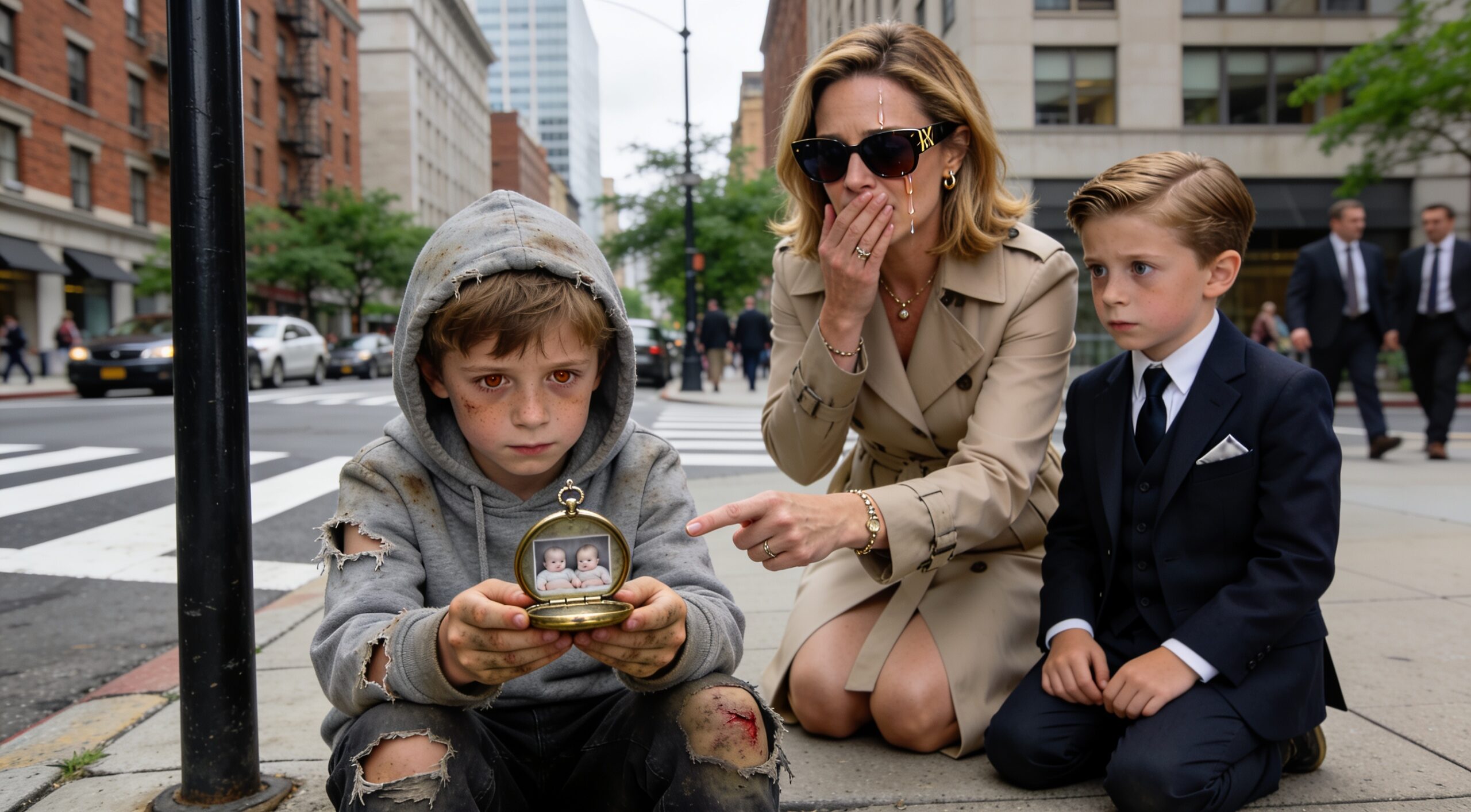
Ethan stood a few steps behind me in his navy suit.
He was seven years old and taking the outfit far more seriously than any seven-year-old should.
His tie was straight.
His hair was combed perfectly.
His shoes had been polished that morning.
He was pointing toward the corner.
“Ethan, don’t point at people.”
“But look.”
I followed his hand.
A boy sat beside a black street pole near the curb.
At first, I noticed the clothes.
Gray hoodie.
Dirty.
Torn at one shoulder.
Dark pants ripped badly at both knees.
Then I noticed the scraped skin on one leg.
Then his face.
I stopped.
Ethan looked at me.
“Why does he look like me?”
The question sounded impossible.
I stared at the boy.
He was close to Ethan’s age.
Maybe seven.
Maybe eight.
His hair was messier.
His cheeks were thinner.
His hood shadowed part of his face.
But Ethan was right.
There was a resemblance.
Not the vague resemblance adults invent when they want to see patterns.
Something sharper.
The eyebrows.
The nose.
The shape of the mouth.
I felt an old fear move through me.
I told myself not to be ridiculous.
Cities are full of faces.
Children resemble strangers.
Memory makes connections where none exist.
I had learned not to trust hope.
Ethan stepped closer to me.
“He looks sad.”
The boy was turning something small in his hands.
Traffic moved behind him.
People passed.
Most did not look.
I said, “Stay beside me.”
We approached slowly.
The boy noticed us.
His shoulders tightened.
I stopped several feet away.
“Hi.”
He said nothing.
“I’m Claire.”
He looked at Ethan.
Then at me.
“Are you okay?”
“I’m fine.”
He was not.
But I did not challenge him.
Ethan looked at the object in his hands.
“What’s that?”
I almost stopped him.
Then the boy answered.
“A locket.”
He held it between his fingers.
It was old.
Brass or bronze.
Scratched.
The edges were worn smooth.
Something about it made my stomach drop before he even opened it.
There are objects the body remembers before the mind does.
I had seen that shape before.
A long time ago.
The boy pushed one dirty thumbnail into the seam.
The locket opened.
Inside was a black-and-white photograph.
Two babies.
I stopped breathing.
The sidewalk disappeared.
So did the traffic.
So did the people around us.
All I saw was that photograph.
Two infant boys lying together under a pale blanket.
The baby on the left had one fist near his face.
The other leaned toward him.
I knew the picture.
I knew it because I had watched it being taken.
Seven years earlier.
Ethan and Noah were six weeks old.
My twins.
The photographer had struggled for twenty minutes to get them both calm.
Noah kept turning his head toward Ethan.
Ethan kept grabbing the blanket.
I had laughed until I cried.
We printed three copies.
One went into a frame.
One stayed in an album.
One was trimmed small enough to fit inside a family locket.
That locket disappeared from my life along with Noah.
My hand rose to my mouth.
Ethan looked up.
“Mom?”
I could not answer.
The boy watched me carefully.
“Did I do something wrong?”
I shook my head.
“No.”
My voice broke.
“Where did you get that?”
He immediately closed his fingers around the locket.
“I’ve always had it.”
“What’s your name?”
He hesitated.
Children who have learned not to trust adults do not hand over information easily.
Finally he said, “Noah.”
I felt my knees weaken.
Ethan looked at me.
Then at the boy.
Then back at me.
My sunglasses hid my eyes, but they could not hide the tears moving down my face.
“Noah,” I repeated.
He looked uncomfortable.
“Yeah.”
Ethan said, “Mom, why are you crying?”
Because once there had been two names.
Ethan.
Noah.
Because once there had been two cribs.
Two sets of tiny socks.
Two hospital bracelets taped into a baby book.
Two boys I thought would spend their whole lives side by side.
Then our family broke apart.
The details were complicated and painful.
Years later, I learned that simple explanations are sometimes kinder than turning family tragedy into a courtroom story.
What mattered was this:
I kept Ethan.
Noah disappeared from my daily life while he was still very young.
At first I believed the separation would be temporary.
Then contact stopped.
Addresses changed.
People moved.
Messages went unanswered.
Years passed.
I searched.
I asked.
I hoped.
Eventually hope became something I carried privately because other people became uncomfortable hearing about it.
“You still think you’ll find him?”
Yes.
I did.
But I stopped saying it aloud.
I built a life around the child I still had.
That child was now standing beside me staring at a boy on a sidewalk.
Ethan pointed at the locket.
“Can I see?”
Noah looked at me.
I said, “Only if you want to show him.”
He opened it again.
Ethan leaned closer.
For a long moment, he stared at the two babies.
Then he touched his own face.
“One looks like me.”
My chest tightened.
“Yes.”
“Which one?”
“The one on the left.”
Ethan looked at the second baby.
“Who’s that?”
I could not say it yet.
Not because I did not believe.
Because belief is not proof.
And a child who has lived through instability does not need a stranger walking up and assigning him a family in fifteen seconds.
So I asked Noah another question.
“Do you know where the locket came from?”
He shrugged.
“I was told it was mine.”
“Who told you?”
“Someone who took care of me when I was little.”
He did not offer more.
I did not push.
“What’s on the other side?”
He turned it.
The opposite half held another faded image.
An adult woman holding a baby.
Time had damaged it.
But I recognized part of the dress.
My dress.
The photograph had been taken in the same first year.
I started crying harder.
Noah looked alarmed.
“I can close it.”
“No.”
I held up my hand.
“No, please. You didn’t do anything wrong.”
Ethan tugged my coat.
“Mom, tell me.”
I took a breath.
“I had two babies.”
He frowned.
“I know.”
“No.”
I looked at him.
“I mean at the same time.”
He stared.
“Twins?”
I nodded.
“You and another little boy.”
His eyes moved instantly toward Noah.
The street boy looked like he wanted to disappear.
I crouched slightly, careful not to move too close.
“I am not going to tell you something I can’t prove,” I said to him. “But that photograph belonged to my family.”
Noah looked at the locket.
Then at Ethan.
“My family?”
“Maybe.”
His face changed on that word.
Maybe.
Hope is dangerous when you have very little.
I saw that immediately.
So I slowed down.
“You do not have to believe me.”
He asked, “Why would you have the same picture?”
“Because I remember the day it was taken.”
Ethan whispered, “Mom.”
I looked at him.
“Was his name Noah?”
My throat tightened.
“Yes.”
Silence.
Ethan looked at the boy.
“Your name is Noah.”
The boy nodded.
None of us knew what to do with that.
A passing car honked.
Somebody shouted from across the street.
The city kept moving.
We stood still.
Then Noah turned the locket over in his hand.
“There’s something on the back.”
I had forgotten.
He flipped it.
Near the hinge was a tiny scratched mark.
Not a name.
Not a number.
A small star.
I knew it.
I had made it myself.
The twins’ father had complained that the two matching lockets looked identical.
So one evening I took a tiny engraving tool and scratched a crooked star into one.
It was badly done.
Uneven.
One side longer than the others.
I remembered laughing at how terrible it looked.
I remembered running my thumb over it.
Now Noah held that exact crooked star in his hand.
I covered my mouth again.
Ethan asked, “What?”
“I did that.”
Noah looked at me.
“You?”
I nodded.
“I scratched that star.”
He stared at the mark.
Then at me.
For the first time, his guarded expression cracked.
Not into joy.
Into confusion.
“You knew this?”
“I knew the locket.”
“Did you know me?”
The question nearly broke me.
“I knew a baby named Noah.”
His face tightened.
I added quickly, “And I have spent years wondering where he was.”
He looked down.
“I don’t remember you.”
“I know.”
That answer mattered.
I did not ask him to.
I did not say, “I’m your mother.”
I did not pull him into a hug.
I wanted to.
Every part of me wanted to.
But he was a child who had learned to guard himself.
So I sat on the edge of the low stone ledge several feet away.
Ethan sat beside me.
After a moment, Noah looked at us.
Then he asked Ethan, “Are you really seven?”
Ethan nodded.
“My birthday was in March.”
Noah’s eyes widened.
“Mine too.”
“What day?”
Noah told him.
Ethan went still.
“Mine too.”
My hands started shaking.
The locket.
The photograph.
The name.
The birthday.
The resemblance.
None of those things alone would have been enough.
Together, they made coincidence almost impossible.
Still, I stayed careful.
I asked Noah whether there was an adult we could call.
He gave me a name.
We made the call.
I arranged food first.
Then clean clothes.
Then medical attention for his knee.
Not because I was trying to buy trust.
Because he was hurt.
That evening, Ethan asked me the same question repeatedly.
“Is he my brother?”
“I think he may be.”
“But is he?”
“We’re going to find out properly.”
He hated that answer.
Children prefer certainty.
So do adults.
Over the next several days, the people responsible for Noah’s care helped us trace what could be traced.
Dates matched.
Old records matched.
Names matched.
The family history matched.
The locket became the emotional piece that connected all of it.
Formal confirmation came later.
By then, my heart had already known.
Ethan met Noah again in a quiet room.
No suits.
No city crowd.
No strangers staring.
Just two boys.
Ethan brought a toy car.
Noah did not know what to do with it.
“It’s for you.”
“Why?”
“Because brothers share.”
I nearly cried again.
Noah looked at him.
“We’re brothers?”
Ethan looked at me.
I nodded.
“Yes.”
Noah did not smile immediately.
Instead, he stared at the floor.
Then he asked:
“Why didn’t you find me?”
There are no perfect answers to that question.
Only true ones.
“I tried.”
He looked at me.
“I should have found you sooner.”
That was also true.
Not because every failure had been mine.
Because explanations do not erase what a child experienced.
He deserved to hear sorrow before excuses.
“I’m sorry.”
Noah held the locket.
“Did you miss me?”
Every day, I thought.
Instead I said:
“Yes.”
He looked at Ethan.
“Did he know about me?”
“No.”
Ethan answered before I could.
“But I know now.”
That was the beginning.
Not a magical instant family.
Not a perfect reunion.
A beginning.
Noah needed time.
Ethan needed time.
I needed time.
The boys were alike in surprising ways.
They both hated tomatoes.
Both slept with one foot outside the blanket.
Both tilted their heads when they were confused.
But they were also different.
Ethan trusted quickly.
Noah watched first.
Ethan talked when nervous.
Noah became silent.
Those differences mattered more than the resemblance.
One afternoon, Noah handed me the locket.
“Can you hold it?”
I took it carefully.
My thumb found the crooked star.
Seven years disappeared.
Then returned all at once.
“Do you want it back?”
He nodded.
I gave it to him immediately.
He closed his hand around it.
“It’s mine.”
“Yes.”
Then he looked at Ethan.
“But he’s in it too.”
“Yes.”
Ethan smiled.
“Good.”
Months later, the boys had a new photograph taken together.
Not babies.
Not posed under a blanket.
Two seven-year-olds sitting side by side.
Ethan wore a sweater.
Noah wore a shirt he had chosen himself.
Neither smiled perfectly.
It was better that way.
We printed one copy small enough to fit into the locket.
Noah refused to remove the old photo.
So we placed the new one behind it.
Past and present.
Two pictures.
Same two boys.
The old photograph did not solve everything.
It did something quieter.
It opened a door.
That afternoon on the sidewalk, Ethan saw a boy who looked like him.
I saw a locket I thought I would never see again.
And Noah saw two strangers crying over a photograph he had carried for as long as he could remember.
None of us understood the whole story in fifteen seconds.
We only understood one thing.
We needed to stop walking.