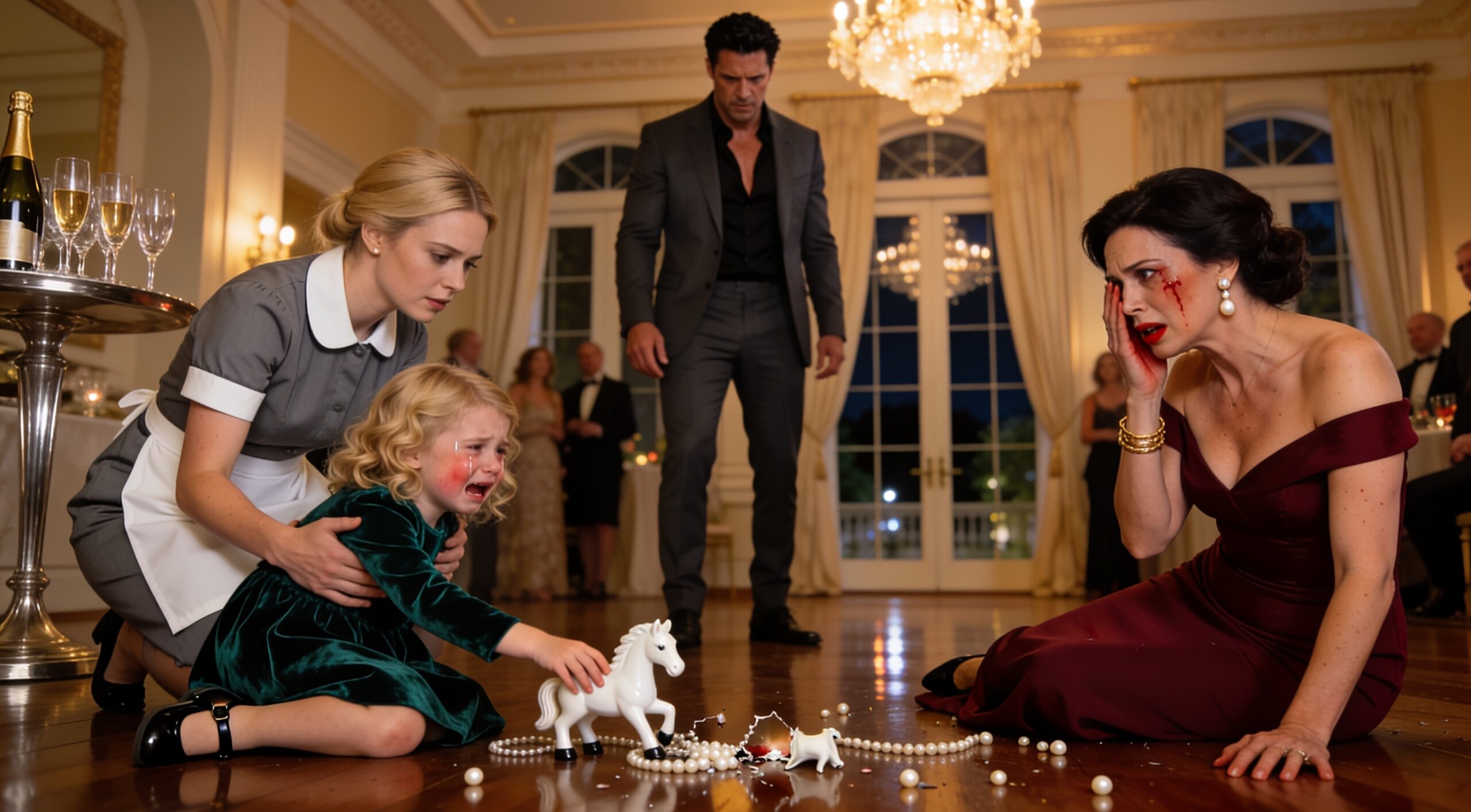
The sound I remember most is not the slap.
It is the pearls.
Tiny white beads striking polished wood and bouncing in every direction.
For a few seconds, the room seemed to watch them instead of us.
Victoria was on the floor.
One hand pressed to her cheek.
A thin line of blood marked the corner of her lip.
Her pearl necklace had torn open when she fell.
And beside the scattered pearls was a small white ceramic horse.
My daughter’s horse.
The entire argument had started there.
Emma was six.
Her mother, Julia, had died a little over a year earlier.
People often asked how Emma was doing.
I never knew how to answer.
Children do not grieve according to adult schedules.
Some mornings she seemed completely normal.
She ate cereal while watching cartoons.
She complained about shoes.
She laughed so hard at stupid jokes that milk came out of her nose.
Then something small would happen.
A song.
A perfume.
A woman with hair like Julia’s.
And suddenly Emma would become quiet.
The white horse was one of those things.
Julia had given it to her on her fifth birthday.
It was inexpensive.
A small ceramic horse with a raised front leg and a painted gray mane.
Nothing anyone would place in a museum.
To Emma, it was priceless.
Julia had spent part of that birthday in bed.
She was already sick.
She still wrapped the horse herself.
Emma carried it to her room that night.
After Julia died, the horse started appearing everywhere.
Breakfast table.
Car rides.
School pickup.
Doctor appointments.
Family dinners.
I never told Emma to stop.
Neither did Sarah.
Sarah Miller had started working with us before Julia died.
At first she helped with household routines.
Then she became the person who knew how to braid Emma’s hair when I failed.
She knew which foods Emma would eat on bad mornings.
She knew when Emma wanted to talk and when she wanted someone simply to stay nearby.
Some relatives believed Sarah had become too important.
My sister Victoria was one of them.
Victoria had always been intense.
Even as children, she believed love meant involvement.
And involvement meant authority.
When Julia was alive, the two women tolerated each other.
After Julia died, Victoria began coming to the house more often.
She wanted to help.
At first, I appreciated it.
Then the advice became instructions.
Emma should stop sleeping with the hallway light on.
Emma should spend less time with Sarah.
Emma should stop bringing the white horse everywhere.
“You are reinforcing the grief,” Victoria told me once.
I asked what that meant.
“She needs to understand life is moving forward.”
“She is six.”
“That’s exactly why you have to guide her.”
I told Victoria that carrying a toy did not concern me.
She sighed as though I were refusing obvious wisdom.
The argument disappeared.
I thought.
Then came the reception.
Victoria was hosting a formal anniversary celebration at the family house.
Hundreds of little details mattered to her.
Flowers.
Lighting.
Champagne.
Seating.
The exact shade of burgundy in her dress.
I considered leaving Emma home.
She wanted to come.
“Will Aunt Victoria be mad if I bring Snow?”
Snow was the horse.
I asked, “Why would she be mad?”
Emma shrugged.
That should have bothered me.
Instead, I said, “Bring whatever makes you comfortable.”
When we arrived, Sarah stayed close to Emma while I greeted guests.
For the first hour, everything seemed fine.
Then I stepped into another room to take a business call.
What happened next came to me later in pieces.
Emma saw the champagne display.
It was tall and glittering under the lights.
She walked closer.
She held Snow in one hand.
She was not drinking anything.
She was not knocking glasses over.
She was simply standing there.
Victoria noticed.
She walked across the room.
“Emma, not near the champagne.”
Emma stepped back.
Then, according to Sarah, Victoria looked at the horse.
“You brought that thing again?”
Emma did not answer.
Victoria reached out.
“Give it to me.”
Emma pulled her hand back.
“No.”
Victoria took it anyway.
That was when Sarah stepped between them.
“Please give it back.”
Victoria looked at her.
“What did you say?”
“Emma is upset. Give her the horse back.”
“You do not tell me what to do in my own home.”
Sarah moved closer to Emma.
“I’m not trying to.”
“You certainly sound like it.”
Emma started crying.
Victoria told her to stop.
That made it worse.
Then she said the sentence Emma later repeated to me.
“Your mother is gone. Carrying this everywhere is not going to bring her back.”
Sarah’s entire expression changed.
“That’s enough.”
Victoria turned on her.
“You stay out of this.”
Sarah crouched and wrapped both arms around Emma.
“No.”
Just one word.
No.
Victoria heard rebellion.
Sarah meant protection.
That was when I walked back into the room.
Guests were watching.
Victoria stood in her burgundy gown holding Snow.
Sarah was crouched on the floor with Emma.
My daughter’s face was buried against her shoulder.
“What happened?”
Victoria answered first.
“Your employee has forgotten her position.”
Sarah looked up.
“She took Emma’s horse and told her to get over her mother.”
The room changed.
Victoria snapped, “That is not what I said.”
Emma lifted her face.
“It is.”
I looked at Victoria.
“Give her the horse.”
“No.”
The answer was immediate.
“Victoria.”
“She cannot carry this forever.”
“That is not your decision.”
“She needs family, Adrian. Not a hired woman encouraging her to stay trapped in the past.”
I looked at Sarah.
Then Emma.
Sarah was not speaking.
She was just holding my daughter.
Victoria continued.
“You have allowed Sarah to become more important than everyone who actually belongs to Emma.”
I said, “She belongs to Emma because she shows up for her.”
Victoria’s face hardened.
“You know what I mean.”
“Yes. I do.”
That was probably the moment I became angrier than I realized.
“You think biology gives you permission to frighten her.”
Victoria stepped toward me.
“I am trying to save that child from being raised in grief.”
“She is grieving.”
“She is being taught to cling to it.”
I told her to give me the horse.
She refused.
Then she grabbed my arm.
Not hard enough to injure me.
Hard enough to stop me from walking past her.
“Do not humiliate me in front of my guests.”
I looked at her hand.
“Let go.”
“No. You are going to listen to me.”
I wish I could tell you I thought carefully about what happened next.
I did not.
I pulled my arm free.
And I slapped her.
Once.
Hard.
The room went silent.
Victoria lost her balance.
She fell.
Her pearl necklace broke.
Pearls rolled across the floor.
Snow fell from her hand.
I stood there breathing hard.
My anger vanished almost instantly.
Victoria touched her cheek.
Her eyes filled.
“You hit me.”
There was a small split at her lip.
I looked at my own hand.
What I had done was wrong.
That truth did not erase what she had said to Emma.
And what she had said to Emma did not excuse what I had done.
Both things could be true.
Then Emma whispered, “Daddy.”
I turned.
She was staring at Snow on the floor.
“Mommy gave me that.”
Victoria looked toward the horse.
She knew.
That was the part that changed my anger into something colder.
“You knew what it was.”
Victoria swallowed.
“I knew Julia gave it to her.”
“And you still took it?”
“She needs to move forward.”
Emma started crying harder.
Sarah picked up the horse.
She checked it.
A tiny chip had appeared on one ear.
Emma saw it.
Her face collapsed.
Sarah immediately said, “We can fix it.”
Victoria sat on the floor among her pearls.
For the first time that night, she looked less angry than ashamed.
I stepped back.
I did not help her up.
Not because I wanted to punish her.
Because I knew my emotions were not under control.
A guest helped her.
Sarah handed Snow to Emma.
I said, “We’re leaving.”
Victoria stood.
“Adrian.”
I looked at her.
“I should not have hit you.”
The words came out in front of everyone.
She stared at me.
I continued.
“That was wrong.”
Her expression changed.
Maybe she expected another justification.
I gave her none.
Then I added, “But you will never speak to Emma like that again.”
Victoria opened her mouth.
I stopped her.
“You do not get to use my mistake to erase yours.”
That sentence mattered.
I did not want Emma learning that hurting someone becomes acceptable if the other person was cruel first.
I also did not want her learning that apologies require surrendering boundaries.
We left.
In the car, Emma sat beside Sarah holding Snow.
She kept touching the chipped ear.
“Can it be fixed?”
“Yes,” Sarah said.
“How?”
“We find someone who knows ceramics.”
“What if they can’t?”
“Then we love it with a chipped ear.”
Emma thought about that.
I nearly cried.
Children understand repair differently from adults.
Sometimes they understand it better.
At home, I told Sarah to put Emma to bed while I called Victoria.
She did not answer.
The next morning she called me.
Her voice was flat.
“I have a bruise.”
“I’m sorry.”
“Sorry does not undo it.”
“I know.”
She was quiet.
Then she said, “You embarrassed me in front of everyone.”
“I did.”
Another silence.
I did not defend myself.
Eventually she said, “Sarah made me look like a monster.”
“No. Sarah protected Emma.”
“She challenged me.”
“You were frightening a child.”
“I was trying to help.”
“Then your idea of help needs to change.”
Victoria began crying.
It was the first time I heard grief underneath her anger.
“I miss Julia too.”
There it was.
Victoria had loved Julia.
More than I realized.
But she had decided Emma’s grief was dangerous because it forced her to see her own.
She wanted the horse gone partly because she hated what it represented.
Loss.
Helplessness.
A sister-in-law who would never walk into another family party.
That did not excuse her.
It explained her.
A week later, Victoria came to the house.
No gown.
No pearls.
No audience.
She asked to speak with Emma.
I stayed in the room.
So did Sarah.
Victoria sat across from my daughter.
“I said something cruel about your mother.”
Emma held Snow.
“Yes.”
“I was wrong.”
Emma looked at the horse.
Victoria continued.
“I also took something that belonged to you.”
“Yes.”
“I thought I was helping you move forward.”
Emma asked, “Why?”
Victoria struggled.
“Because I miss your mom too, and sometimes seeing things that remind me of her hurts.”
Emma stared at her.
Then she said, “It hurts me too.”
Victoria began crying.
That was the moment the entire conflict became smaller and sadder.
Not less serious.
Just more human.
Victoria apologized to Sarah next.
That was harder.
“I treated you like your job made your care less important.”
Sarah nodded.
“It doesn’t.”
“I know that now.”
I apologized too.
Not to make everything symmetrical.
It was not.
I apologized because I hit my sister.
She had been cruel.
I had become physical.
Both required accountability.
We did not return to normal immediately.
Victoria stopped hosting Emma alone for a while.
She respected that boundary.
Sarah remained in Emma’s life.
Nobody called her “the help” again.
Snow was repaired by a local ceramic artist.
The chip on the ear was still faintly visible.
Emma loved that.
“It has a scar,” she said.
“So do people.”
Sarah smiled.
Months later, Victoria visited again.
Emma brought Snow into the room.
For one second, Victoria looked uncomfortable.
Then she smiled.
“Still traveling with you?”
Emma nodded.
“For now.”
Victoria said, “That’s okay.”
Two words.
That’s okay.
No lecture.
No demand to move on.
No attempt to control how a child remembers her mother.
That was progress.
I still think about the slap.
I do not tell the story as if it made me heroic.
It did not.
Protecting my daughter was right.
Losing control was not.
The line matters.
The thing I am proud of is what happened afterward.
We did not pretend the violence was justified.
We did not pretend Victoria’s cruelty was harmless.
We named both.
We repaired what could be repaired.
The horse.
The relationship.
The trust.
Not perfectly.
The faint crack remained.
Maybe that was appropriate.
Because repair does not always erase damage.
Sometimes it simply makes something safe to hold again.