My mother-in-law had one hand on my daughter’s shoulder when I walked into the room.
Sophie was crying.
Not loudly.
Not dramatically.
The quiet kind of crying children do when they are trying very hard not to make adults uncomfortable.
Her face was red.
Her shoulders were trembling.
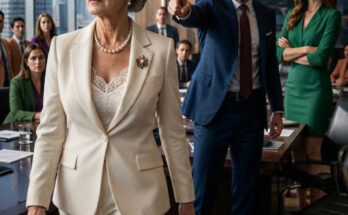
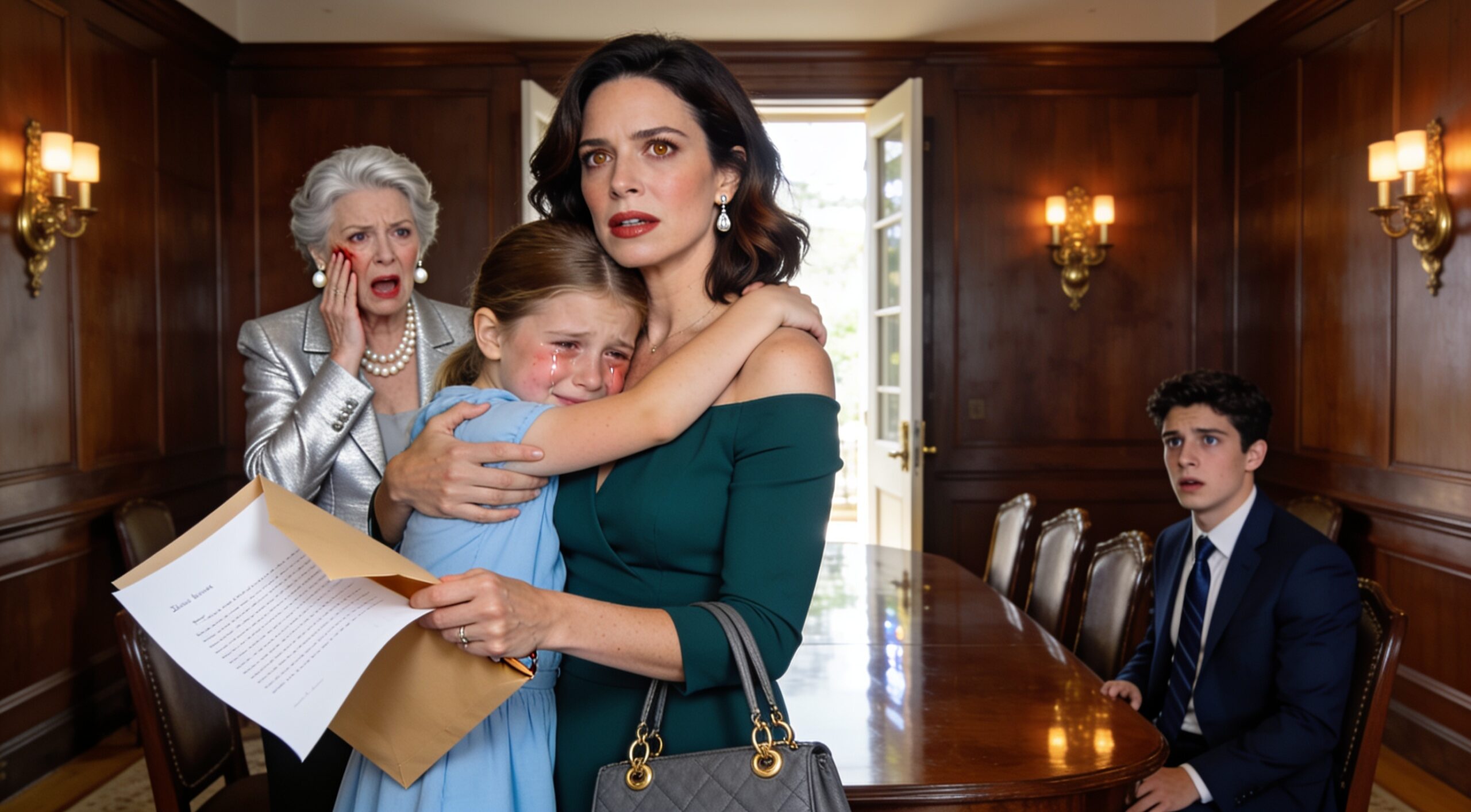
Evelyn stood behind her in a silver jacket and pearls, looking furious.
“Enough,” she said.
Sophie wiped her face.
“I’m trying.”
“Then try harder.”
That was the first thing I heard clearly.
I stopped beside the long wooden table.
Ryan, my husband’s younger brother, sat several chairs away in a navy suit.
He looked down.
Nobody moved.
Then Evelyn said, “Your father would be ashamed to see you like this.”
Sophie’s face collapsed.
I crossed the room.
“Take your hand off her.”
Evelyn looked at me.
For six months, we had been circling the same fight.
This was simply the first time it became impossible to avoid.
My husband Michael died after a long illness.
He was forty-two.
Sophie was seven.
There is no graceful way to explain death to a child who still expects the front door to open at five thirty.
For weeks after the funeral, Sophie asked the same question.
“Is Dad really never coming home?”
I answered honestly.
Then she would ask again two days later.
Grief is repetitive.
Adults dislike that.
Children do not care.
They ask until the impossible answer starts to feel real.
Evelyn loved Michael fiercely.
He was her oldest son.
He was the person she called when something broke in the house.
The one who remembered her appointments.
The one who knew exactly how she liked her coffee.
When he died, part of Evelyn became hard.
At first I understood.
Then the hardness started landing on Sophie.
If Sophie cried at dinner, Evelyn told her to breathe and stop.
If Sophie wanted to carry Michael’s old scarf in the car, Evelyn said she needed to stop clinging.
If Sophie asked to hear one of his voice messages, Evelyn left the room.
Once, she told me privately, “You have to teach her to move forward.”
I said, “She is moving forward.”
“She still cries every week.”
“So do I.”
“You’re an adult.”
“I’m his wife.”
Evelyn looked at me as if that proved her point.
I did not want a war with her.
She had lost her son.
I had lost my husband.
Sophie had lost her father.
We were all standing around the same hole, blaming one another for how we looked into it.
Then a package arrived.
It came from a box of Michael’s things that had been stored after his death.
Inside was a tan envelope.
My name was written on the front.
Underneath, in Michael’s handwriting, were four words:
Open when you need this.
I carried it for three days.
I did not open it.
I was afraid.
A last letter is a dangerous thing.
As long as it stays sealed, the person who wrote it can still say anything.
Once you open it, the final words become fixed forever.
So I put it inside my gray handbag.
Then Evelyn invited us to a family dinner.
I almost declined.
Sophie said she wanted to go.
“Uncle Ryan will be there?”
“Yes.”
“And Grandma?”
“Yes.”
She hesitated.
Then nodded.
That should have told me more than it did.
The dinner started quietly.
Ryan talked about school.
Evelyn asked Sophie about reading.
I drank water and tried not to notice how tightly Sophie was holding my hand under the table.
Then Ryan mentioned Michael’s birthday.
He did not mean to cause anything.
He said, “I was thinking maybe we could do something for Mike next month.”
Sophie froze.
Her lower lip trembled.
Then she started crying.
“I miss him.”
Ryan immediately said, “I know, Soph.”
Evelyn’s expression changed.
Not sadness.
Frustration.
“Please.”
Sophie looked at her.
“What?”
“Not again.”
The room became very still.
I said, “Evelyn.”
She ignored me.
She stood and moved behind Sophie.
One hand settled on the child’s shoulder.
“Your uncle is trying to talk about remembering your father. You do not have to turn every mention of him into tears.”
Sophie tried to stop crying.
That was the worst part.
She was trying to obey.
“I’m sorry.”
Evelyn squeezed her shoulder.
“Then stop.”
I stood.
“Take your hand off her.”
Evelyn turned.
“No.”
I crossed the room.
“Sophie is allowed to cry.”
“She has been allowed to cry for six months.”
“She can cry for sixty years if she needs to.”
“That is exactly the problem.”
I stared at her.
“What problem?”
“You reward it.”
“Reward what?”
“The helplessness.”
Sophie was listening.
That mattered more than anything.
I lowered my voice.
“Do not call her grief helplessness.”
Evelyn’s mouth tightened.
“I raised Michael to be strong.”
“And?”
“And he would not want his daughter turning into this.”
Sophie looked up.
That was when I saw fear on her face.
Not fear of Evelyn hitting her.
Fear that her father might somehow be disappointed in her.
I stepped between them.
“Do not speak for him.”
“I am his mother.”
“And I was his wife.”
“I knew him before you existed in his life.”
“That does not mean you own his memory.”
Ryan stood.
“Mom, stop.”
Evelyn looked at him.
“You stay out of this.”
Then she turned back to me.
“You are making Sophie weak because you are too weak to let Michael go.”
I felt anger rise.
I tried to control it.
“Back away from my daughter.”
Evelyn did not.
Instead she said, “Michael would be ashamed of the woman you’ve become.”
That was the moment.
I slapped her.
Once.
Hard.
The sound filled the room.
Evelyn’s head turned.
Ryan froze.
Sophie screamed, “Mom!”
My hand dropped immediately.
The anger disappeared as fast as it had arrived.
I knew.
No justification required.
I knew it was wrong.
Evelyn touched her cheek.
Her eyes widened.
“You hit me.”
I stepped back.
“Yes.”
The word felt terrible.
I looked at Sophie.
She was crying harder now.
That made everything worse.
I had wanted to defend her.
Instead I had given her another frightening thing to remember.
I turned away from Evelyn.
No second slap.
No continued fight.
I opened my handbag.
My fingers found the tan envelope.
I pulled it out.
Then I lifted Sophie into my arms.
She wrapped both arms around my neck.
“I want to go home.”
“We’re going.”
I walked toward the front door.
Behind us, Evelyn shouted, “Claire, you do not get to assault me and walk away.”
I stopped.
I looked back.
“You are right.”
She seemed surprised.
“I should not have hit you.”
Ryan looked between us.
I continued.
“But that does not mean you were right to tell a seven-year-old her father would be ashamed of her grief.”
Evelyn’s face hardened again.
“I was trying to help her.”
“No. You were trying to make her grieve in a way that made you comfortable.”
Then I walked outside.
The air was bright and warm.
Sophie still clung to me.
I sat on the stone bench near the entrance.
The envelope was in my hand.
For reasons I still cannot explain, I opened it.
Maybe after what had happened, I could not tolerate one more unopened thing.
I tore the seal.
There were three typed pages.
The first line was simple.
Claire,
If you are reading this, something probably got harder than we hoped.
I stopped breathing.
Sophie lifted her head.
“Is it Dad?”
I nodded.
“Can I hear?”
I looked at her.
“Maybe.”
I read.
Michael wrote about ordinary things first.
He told me where he hid the spare watch Sophie liked.
He apologized for leaving too many passwords undocumented.
He made a joke about Ryan stealing his tools.
Then the letter changed.
I need you to protect Sophie from the people who love her badly when they are afraid.
I read the sentence again.
People who love her badly when they are afraid.
Then:
My mother loves hard. Sometimes so hard that she mistakes control for strength.
My eyes lifted toward the open doorway.
Evelyn was still inside.
I kept reading.
If Sophie cries for me, let her cry.
If she asks the same question twenty times, answer twenty times.
If she sleeps with my old sweatshirt, let her.
If she wants to laugh the next day, let her do that too.
There is no correct performance of missing someone.
My vision blurred.
Sophie whispered, “What does it say?”
I held her closer.
“It says Dad knows you.”
She cried again.
This time I did not try to stop it.
Then came the line that made me look back into the house.
If my mother ever tells Sophie to stop crying for me, remind her that grief is love with nowhere to go.
I stared at the page.
Michael had written Evelyn into the letter.
Not because he hated her.
Because he knew her.
He knew how she reacted to pain.
By organizing it.
Controlling it.
Telling it when to stop.
I turned around.
Evelyn was standing inside the doorway.
Her hand was still against her cheek.
Ryan stood behind her.
I walked back in.
Not close enough for another confrontation.
Just close enough to be heard.
“Michael wrote about you.”
Evelyn laughed bitterly.
“Of course he did.”
“No.”
I held up the letter.
“He knew you might do this.”
Her expression changed.
“What does that mean?”
I read the line aloud.
If my mother ever tells Sophie to stop crying for me, remind her that grief is love with nowhere to go.
Nobody moved.
Evelyn looked at Sophie.
Then at me.
“That is not real.”
I almost became angry again.
Instead, I handed Ryan the page.
He read it.
His eyes filled.
“It’s Mike.”
Evelyn stared at him.
Ryan continued reading silently.
Then he looked at his mother.
“He knew.”
Evelyn sat down.
For the first time that evening, she looked old.
Not elegant.
Not powerful.
Old.
“I was trying to make her strong.”
Sophie whispered from my arms, “I’m trying to be strong.”
Evelyn looked up.
Sophie continued.
“But I still miss Dad.”
Something in Evelyn’s face broke.
“So do I.”
Sophie said, “Then why can’t I cry?”
There are questions adults spend years avoiding that children can ask in five words.
Evelyn covered her face.
She began crying.
Not quietly.
Not neatly.
The exact kind of grief she had been demanding Sophie control.
I did not feel victorious.
I felt sad.
Ryan sat beside her.
Sophie watched.
Then she asked me to put her down.
I hesitated.
She touched the floor.
She walked toward Evelyn.
Not all the way.
Just close enough.
“Grandma?”
Evelyn looked up.
“I’m sorry.”
Sophie nodded.
Then she said, “Mom hit you.”
I closed my eyes.
There it was.
No adult could hide behind the moral clarity of the moment.
I had been wrong too.
I crouched beside Sophie.
“Yes.”
She looked at me.
“You say we don’t hit.”
“I do.”
“Then why did you?”
Because I was angry sounded pathetic.
Because Grandma was cruel sounded like an excuse.
So I told the truth.
“I lost control.”
Sophie looked at Evelyn.
Then back at me.
“You have to say sorry.”
“Yes.”
I stood.
I faced Evelyn.
“I am sorry I hit you.”
She stared at me.
I added, “I was furious. That does not make it acceptable.”
Evelyn touched her cheek.
“I don’t forgive you yet.”
“That’s fair.”
Then I said, “And I am still taking Sophie home.”
Her expression tightened.
I held up Michael’s letter.
“You do not get to shame her grief again.”
Evelyn looked at the page.
Then at Sophie.
“I won’t.”
We left.
The next weeks were awkward.
Evelyn did not call for several days.
When she finally did, she asked to speak with Sophie.
I stayed nearby.
She said, “I told you something about your dad that I had no right to say.”
Sophie listened.
“I said he would be ashamed of your tears.”
Evelyn’s voice cracked.
“I was wrong.”
Sophie asked, “Would he?”
“No.”
“How do you know?”
Evelyn was quiet.
“Because he wrote it.”
That mattered.
Michael’s words became neutral ground.
Not mine.
Not Evelyn’s.
His.
The next month would have been his forty-third birthday.
We gathered again.
Smaller group.
No formal table.
No tension hidden under manners.
Sophie brought Michael’s old sweatshirt.
Evelyn saw it.
For one second I watched the old instinct cross her face.
Then she said nothing.
Later Sophie cried.
Evelyn cried too.
Nobody told either of them to stop.
Ryan read one paragraph from Michael’s letter.
The last one.
This was the message Michael had written directly for Evelyn.
Mom, if you are reading this because you and Claire are fighting over Sophie, please remember something.
She is not a project.
She is not a legacy.
She is not the piece of me you need to control because you could not keep me.
She is a child.
Love her in the way she needs, not only in the way that makes sense to you.
Evelyn lowered her head.
I reached for her hand.
Not because everything was repaired.
It was not.
The slap still happened.
The cruelty still happened.
Trust does not reset because a dead man wrote beautiful sentences.
But something changed.
We stopped competing over who had the right to grieve Michael correctly.
Sophie showed us how ridiculous that had been.
Months later, the letter is still in my gray handbag.
Not because I am afraid to put it somewhere safe.
Because sometimes I need it.
Sometimes Evelyn does too.
Once, Sophie asked if she could keep it.
I told her one day.
For now, I read parts of it when she asks.
Her favorite line is not the dramatic one.
It is this:
If she needs you, hold her.
Simple.
That night in Evelyn’s mansion, I did hold her.
I also made a terrible choice in anger.
Both truths belong to the story.
I protected my daughter.
I hit another person.
Evelyn loved Sophie.
She also hurt her with words.
Nobody became innocent because somebody else was wrong.
That was the lesson Michael’s letter forced on all of us.
Grief does not make cruelty acceptable.
Anger does not make violence acceptable.
And love does not give anyone ownership over another person’s pain.
Sophie still cries for her father.
So do I.
So does Evelyn.
Now we let each other.