I destroyed Robert Hayes’s coffin during his funeral because I knew the man inside was not Robert.
For twelve years, I served as Robert’s caregiver and household manager at his Richmond mansion.
Robert was sixty-eight years old, completely silver-haired, and had a surgical scar behind his right ear. He was demanding, private, and sometimes difficult, but he treated me with respect.
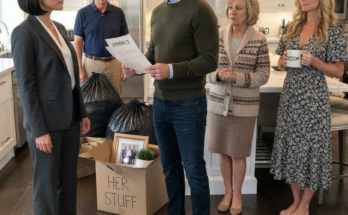
His son Ethan did not.
Ethan believed every employee was replaceable and every part of Robert’s estate already belonged to him.
Three days before the funeral, Ethan called to say Robert had died in a vehicle fire.
He refused to identify the hospital or explain why Robert’s attorney had not been notified.
The announcement became more suspicious because Robert had recently discovered that $2.3 million was missing from Hayes Development Group.
Robert suspected Ethan.
The night before the supposed accident, Robert left me a voicemail instructing me not to let Ethan remove anything from his study.
He planned to meet attorney Rebecca Cole the following morning.
That meeting never occurred.
At the funeral, Ethan refused to let anyone open the inner coffin panel. He claimed Robert’s injuries were too severe.
Then I saw dark curly hair beneath the edge.
Robert had silver hair.
I demanded that the funeral director open the coffin.
He refused because Ethan and Robert’s wife, Eleanor, had signed instructions requiring it to remain sealed.
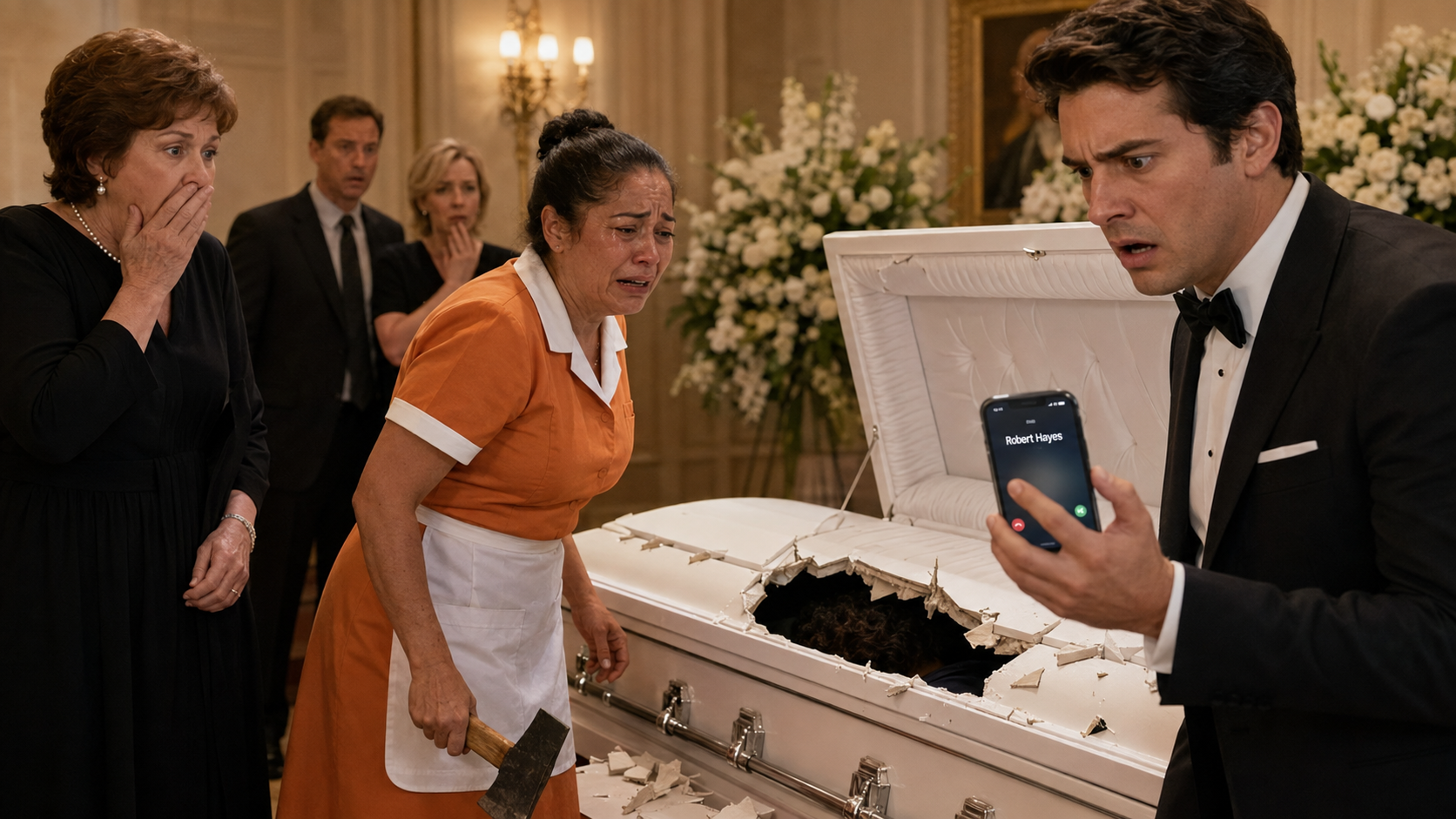
I took an emergency axe from the chapel wall and broke through the inner panel.
The man lying inside was not Robert.
He was Michael Lane, a maintenance supervisor employed by the Hayes company.
While the family stood around the broken coffin, my phone rang.
The caller identification showed Robert’s name.
Robert was alive.
He whispered that he had been locked inside an unknown building and that Ethan knew where he was.
Police traced the phone signal to an abandoned rehabilitation center outside Fredericksburg.
Officers found Robert sedated but conscious in a locked treatment room.
A private nurse named Allison Price was caring for him. She had been told Robert suffered from severe confusion and had been legally placed under Ethan’s guardianship.
Every supporting document was forged.
The investigation reconstructed the conspiracy.
Robert had discovered that Ethan moved company money into a private development project controlled by his friend, security contractor Travis Cole.
The project failed.
Instead of admitting the loss, Ethan created false invoices and transferred more money to hide the original deficit.
Michael Lane discovered irregular activity at a company warehouse. He photographed shipping records showing that Travis used Hayes vehicles to move materials for his private business.
Michael planned to give the information to Robert.
The night before Robert’s board meeting, Travis confronted Michael at the warehouse.
Michael died during the confrontation.
Investigators concluded that his death was not originally planned, but Travis and Ethan immediately turned it into an opportunity.
They placed Michael’s body inside Robert’s damaged company car and set the vehicle on fire.
They then used Robert’s medical and dental records to identify Michael as Robert.
Because Michael and Robert had similar builds and the body was badly damaged, the rushed identification passed initial review.
Ethan arranged for the coffin to remain sealed.
Michael’s relatives were told that he had resigned and moved out of state. Ethan sent text messages from Michael’s phone to support the lie.
Robert was taken from his home using a private medical vehicle.
Travis told the driver Robert was an unstable patient being transferred under emergency family authority.
Robert was sedated and held in the abandoned rehabilitation center.
Ethan planned to keep him there for thirty days.
During that period, Ethan would control Hayes Development Group as temporary chairman.
He intended to sell company properties to businesses connected to Travis, recover the missing money, and later release Robert.
Ethan imagined Robert would remain silent to protect the family name.
Robert had protected Ethan from consequences many times before.
This time, he had already prepared evidence.
Before the attack, Robert created a scheduled email containing banking records and an audio recording of his confrontation with Ethan.
Rebecca received the email during the funeral.
The recording captured Ethan admitting that he had transferred company funds.
It also contained Robert’s refusal to conceal the theft.
Police arrested Ethan on charges connected to fraud, kidnapping, forgery, conspiracy, and the concealment of Michael Lane’s death.
Travis had already fled the rehabilitation center.
He was arrested four days later at a private airfield in North Carolina while attempting to leave using another man’s identification.
He carried $180,000 in cash and a drive containing property-transfer agreements.
Eleanor’s role was more complicated.
She admitted that Ethan told her Robert survived the crash but had suffered permanent brain damage.
He convinced her that announcing Robert’s death would prevent the company board from removing the family from control.
Eleanor signed the sealed-coffin authorization and several temporary estate documents.
She claimed she believed Robert was receiving private medical treatment.
However, investigators found Robert’s original medical records in her safe.
Those records had been used to misidentify Michael’s body.
Eleanor eventually admitted she gave the records to Ethan.
She said she never asked why he needed them.
The court determined that Eleanor did not know Michael had died or that Robert was being held against his will.
But she knowingly participated in the false death announcement and signed property documents without Robert’s consent.
She pleaded guilty to fraud-related charges and obstruction.
She avoided prison after cooperating, but received probation, community service, financial penalties, and a permanent prohibition against controlling Robert’s medical or financial affairs.
Robert returned to the mansion six weeks after the funeral.
He walked slowly and required physical therapy, but his mind remained clear.
I was present when he entered the front hall.
He stopped beneath the family portrait and looked around the house.
“Did they move anything from my study?” he asked.
It was the most Robert-like sentence he could have said.
“No,” I answered. “I locked it.”
For the first time since I had known him, Robert hugged me.
Michael Lane’s family finally learned what happened to him.
Robert personally met Michael’s mother and adult daughter. He explained that Michael died after trying to expose theft from the company.
Hayes Development Group paid for Michael’s real funeral and established an education fund for his granddaughter.
Robert did not describe the payment as compensation for Michael’s life.
“No amount of money can make this fair,” he told the family. “It can only acknowledge that he tried to do the right thing.”
The white coffin from the first funeral was preserved as evidence.
I never saw it again after investigators removed it from the chapel.
For months, I woke from dreams hearing the axe strike the wood.
A family counselor later asked whether I regretted destroying it.
I regretted frightening the mourners.
I regretted that Michael’s body was treated as part of someone else’s deception.
But I did not regret opening the coffin.
Without that moment, Ethan would have become temporary chairman.
Company properties would have been sold.
Robert might have remained missing until the scheme was complete—or permanently.
Ethan eventually pleaded guilty after Travis agreed to testify.
Evidence showed Ethan did not directly cause Michael’s death, but he helped conceal it, staged Robert’s death, authorized the kidnapping, forged financial documents, and attempted to steal control of the company.
He received a lengthy prison sentence.
Travis received a longer sentence for Michael’s death, Robert’s abduction, fraud, and conspiracy.
Robert removed Ethan from every company position and changed his estate plan.
He did not leave the entire fortune to me, despite what some newspapers later claimed.
He placed most of his wealth into an independently administered foundation supporting whistleblowers, elder-fraud victims, and families affected by workplace corruption.
He left Eleanor enough to live safely but gave her no authority over the foundation or company.
He sold the Richmond mansion two years later.
The house held too many memories of betrayal.
Before moving, Robert gave me the small brass key to his study.
“You protected what was behind that door,” he said.
I still keep the key.
Robert lived another seven years.
During that time, he rebuilt the company board, repaid every misused account, and testified publicly about financial exploitation within families.
He never reconciled fully with Ethan.
They exchanged several letters, but Robert refused to describe forgiveness as forgetting consequences.
“Love does not require pretending the crime never happened,” he once told me.
After Robert eventually died from natural causes, Rebecca called me before announcing anything publicly.
She invited me to the hospital.
She showed me the identification bracelet, physician’s report, and every document.
Robert had left explicit instructions:
Maria is to see the truth before anyone closes the coffin.
His second funeral was small.
There was no sealed panel.
There were no enormous floral displays or reporters.
Michael Lane’s daughter attended.
So did several former employees Robert had helped through the foundation.
I stood beside the coffin and placed the brass study key near his hand.
Seven years earlier, Ethan believed a closed coffin could turn a living man into a legal memory.
He believed money, forged documents, and a sealed wooden panel could prevent anyone from asking questions.
He underestimated one person.
The employee he repeatedly dismissed as “only the caregiver” knew Robert’s silver hair, his medical history, his voice, and the way he prepared for betrayal.
I broke the coffin because the dark-haired man inside could not have been Robert Hayes.
Then Robert called my phone.
And the funeral designed to give Ethan control became the moment his entire plan was finally opened.