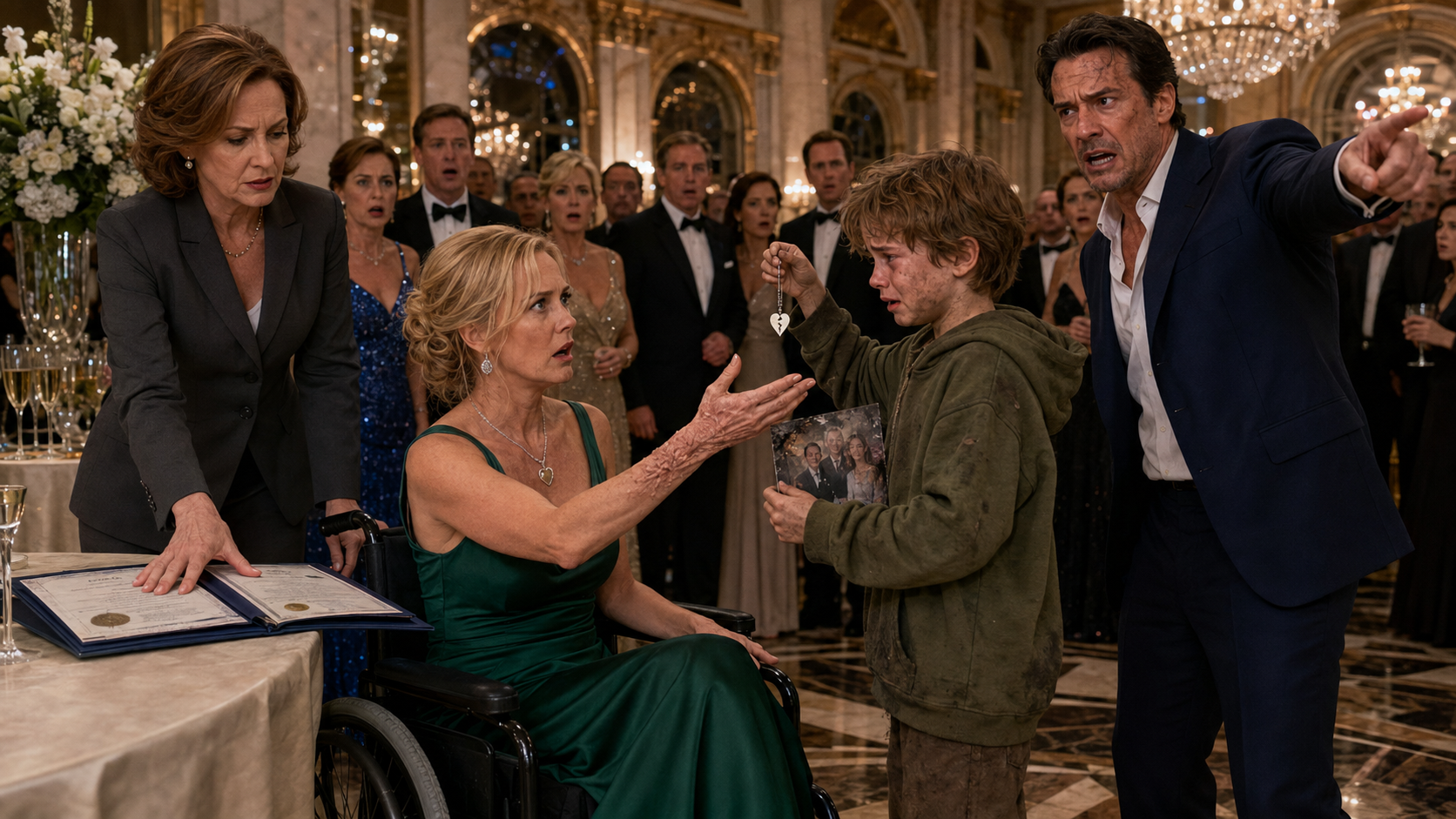
A dirty ten-year-old boy pushed through a ballroom filled with millionaires, pointed at my fiancé, and screamed:
“YOU TOLD ME MY MOM WAS DEAD!”
My name is Claire Whitmore.
That evening, I was seated in my wheelchair beneath the crystal chandeliers of a luxury Boston hotel while hundreds of donors waited for Victor Hale and me to announce our engagement.
Victor had been my late husband David’s business partner.
After a highway tunnel fire killed David, damaged my memory, and left me unable to walk, Victor became the temporary manager of the Whitmore companies and my court-appointed financial guardian.
He controlled my medical appointments, finances, visitors, and legal affairs.
Most importantly, he controlled the story of what happened to my son.
When I woke after seven weeks in a coma, I repeatedly asked for Owen.
Victor showed me a death certificate and said my five-year-old son had died before firefighters reached the vehicle.
I never saw Owen’s body.
Victor said the injuries were too severe.
He arranged a private funeral while I remained in rehabilitation and placed a sealed urn in our family mausoleum.
For five years, I blamed myself for surviving.
I remembered only fragments from the crash: broken glass, smoke, David motionless behind the steering wheel, and a child screaming from the back seat.
The most vivid memory was heat spreading across my right hand as I reached through the flames.
Doctors called those images traumatic fragments.
Victor repeatedly told me they did not prove Owen survived.
Over time, I became dependent on him.
Two months before the charity gala, he proposed.
I accepted because I confused control with protection.
Then Owen walked through the ballroom doors.
He wore an oversized olive-green hoodie, worn brown pants, and muddy sneakers. Dirt streaked his face. Tears filled his eyes.
He ignored the guests staring at him.
He walked directly toward me.
“You told me my mom was dead!” he screamed at Victor.
Victor stepped between us and ordered security to remove him.
Owen shouted that I had pulled him from the fire and told everyone to look at my hand.
The branching scar across my fingers and wrist began trembling.
I ordered the guards to stop.
Owen approached carefully and touched the scar.
“You promised you’d come back for me, Mom.”
The memory returned with terrifying clarity.
Owen trapped beneath a seat belt.
My hand burning as I reached through the rear window.
His small fingers gripping mine.
His voice screaming for me not to let go.
I said his name.
Victor turned pale.
Owen produced a smoke-damaged photograph showing us together before the crash.
He also carried one half of a silver heart pendant.
The matching half hung beneath my gown.
When the pieces joined perfectly in my scarred palm, I knew before any laboratory could confirm it.
The child standing before me was my son.
Victor called the evidence fake.
My estate attorney Rebecca Sloan entered the ballroom with a dark-blue legal folder.
She presented Owen’s birth certificate and a preliminary kinship report supporting our biological relationship.
Then she displayed the death certificate Victor had used to convince me Owen was gone.
It had been issued nine days before the tunnel fire.
That was not a mistake.
It was preparation.
Child-services investigator Grace Miller opened Owen’s placement file.
Four days after the fire, a private agency registered him as Evan Reed.
The agency reported that his parents were dead and that trauma made the child unable to identify himself reliably.
Owen had never forgotten his name.
He had never forgotten mine.
He told caseworkers that Claire Whitmore was his mother and that she survived the fire.
Whenever an adult began investigating his claims, he was moved.
During five years, Owen lived in six different placements.
Some caregivers treated him kindly.
Others considered his insistence that I was alive a behavioral problem.
Twice, Owen ran away trying to reach Boston.
Each time, Victor’s private placement company paid to move him farther away.
Owen wrote me thirty-seven letters.
Every envelope carried my name and the address of the Whitmore mansion.
Victor’s assistant redirected them to a private post-office box.
The letters remained unopened.
The earliest contained drawings of our home.
The final letter showed a blonde woman in a wheelchair wearing one half of a heart pendant.
At the bottom, Owen wrote:
**Mom, I know you are still alive.**
Rebecca then revealed the financial reason Victor needed Owen to disappear.
David had created a trust protecting the Whitmore estate for our son.
If Owen lived, Victor could manage the companies only temporarily.
If Owen died and I remained medically incapable, Victor’s guardianship agreement allowed him to seek permanent control over the estate.
The agreement covered the mansion, foundation, investment accounts, and family companies.
Victor needed me alive, dependent, and legally childless.
He used my damaged memory to create that condition.
The engagement was the next stage of his plan.
A week after the gala, Victor intended to ask the court to declare me permanently incapable of managing my finances.
Marriage would have strengthened his claim to control everything.
I removed my engagement ring and dropped it onto the guardianship agreement.
Victor shouted that he had protected me.
I answered that he had buried an empty coffin and forced me to mourn a living child.
The investigation moved to the Whitmore mansion the following morning.
Detective Marcus Hill opened a hidden safe behind a family portrait in Victor’s office.
Inside were my original medical records, Owen’s intercepted letters, false foster-placement documents, and the petition declaring me permanently incompetent.
The safe also contained financial statements showing that $3.8 million had been transferred from Owen’s protected inheritance into property companies connected to Victor.
Rebecca accused Victor of stealing from a child he had declared dead.
Victor shouted that the money had saved the company.
The records showed otherwise.
The money paid for private properties, luxury travel, personal debts, and the placement agency that kept Owen under a false name.
A black flash drive contained recorded video of Victor paying the agency director.
“Keep the boy under another name,” Victor said in the recording. “If Claire remembers him, everything changes.”
The agency director later claimed he believed Victor was protecting the family from publicity.
Investigators found emails showing he knew Owen’s mother was alive.
He had been paid to suppress the truth.
The red legal folder in the safe contained a letter from David.
David wrote it two days before the crash after discovering Victor’s missing transfers.
He warned that Owen’s inheritance rights prevented Victor from taking permanent control.
The letter said:
**If anything happens to us, find Owen before Victor finds a way to erase him.**
Attached to the letter was a tunnel-camera photograph.
It showed Victor standing beside our damaged vehicle before the fire spread.
He was not helping David or searching for Owen.
He was removing a black document case from the trunk.
Detectives found the same case inside the safe.
It contained the original trust ledger David intended to deliver at an emergency board meeting.
Phone and payment records showed Victor had hired a driver to force our car to stop before David reached that meeting.
Victor later claimed he expected only a minor collision.
The hired driver forced our vehicle toward the tunnel barrier.
The impact damaged the fuel system and started the fire.
David died at the scene.
I freed Owen from the rear seat and pushed him through a shattered window.
A second explosion separated us.
A paramedic carried Owen to another ambulance while I lost consciousness.
Victor found him at a different hospital before our relatives did.
He told staff that Owen’s parents were dead and presented prearranged documents from the private agency.
He then returned to my hospital, waited for me to wake, and showed me the false death certificate.
The investigation uncovered one additional betrayal.
My cousin Margaret Ellis, then a junior officer in the Whitmore trust department, had signed the first transfer authorizing Victor to move company money.
Margaret claimed Victor told her the transfer was an emergency payment to protect employee salaries.
She later discovered the destination was a private property company.
Instead of reporting it, she remained silent because Victor threatened to expose her signature and blame the entire theft on her.
After the crash, Margaret gave Victor access to a family identification file containing Owen’s birth records.
She insisted she did not know he planned to change Owen’s identity.
However, her silence gave Victor the documents he needed.
Margaret cooperated with investigators and testified against him.
She was not charged with the crash or Owen’s abduction, but she lost her position, repaid the money tied to her authorization, and was permanently barred from managing family funds.
Victor, the hired driver, and the placement director faced criminal charges.
Victor originally denied arranging the collision.
Messages, payments, the traffic photograph, and the driver’s testimony proved the plan.
Victor eventually pleaded guilty to financial fraud, custodial interference, forgery, conspiracy, evidence destruction, and charges connected to David’s death.
He received a lengthy prison sentence.
The placement director also pleaded guilty.
The driver received a reduced sentence in exchange for complete testimony.
The legal judgment mattered because it recorded the truth clearly:
Owen had never been abandoned.
He had never been forgotten intentionally.
His identity had been stolen by adults who profited from keeping us apart.
The family court restored Owen’s legal name immediately.
My parental rights had never been lawfully terminated, but the court did not send him home with me on the first night.
Five years of separation could not be repaired by one dramatic reunion.
For several weeks, Owen lived in a safe temporary home near Boston while we attended daily visits and trauma therapy.
I hated every hour apart.
But for the first time, Owen knew exactly where I was.
He had my phone number.
He knew the date and time of every visit.
I never allowed a schedule to change without explaining it to him.
The court also evaluated whether my disability prevented me from parenting.
My wheelchair did not make me incapable.
The mansion received accessible modifications, and professional aides were hired for tasks related to my physical needs.
Owen was never expected to become my caregiver.
He was allowed to be ten years old.
Physical custody was restored after eight weeks.
Outside Suffolk County Family Court, Victor was escorted past us after another hearing.
He shouted that he had kept the family alive.
I answered:
“You kept a mother and child apart for five years.”
Owen stepped beside me and said:
“We lost each other because of you.”
Rebecca raised the trust-restoration order.
Most of the stolen funds had been recovered through property seizures and frozen accounts.
An independent fiduciary now controlled Owen’s inheritance.
Neither I nor any future guardian could make large withdrawals without outside review.
The trust paid only for Owen’s education, therapy, medical care, and long-term security.
I paid our normal household expenses from my personal income.
I needed Owen to understand that he was loved as my son, not valued as an heir.
Our first months together were complicated.
Owen hid food beneath his bed because some foster placements had ended without warning.
He slept in his hoodie because he feared he might need to leave quickly.
He checked the driveway whenever I was late returning from therapy.
One night, he asked whether I might forget him again.
I told him:
“I did not choose to forget you. But I will choose every day to remind you that you belong here.”
He slowly stopped packing emergency bags.
He began leaving his shoes by the front door.
He put family photographs on his bedroom wall.
He also kept copies of all thirty-seven letters in a scrapbook.
Rebecca later gave us a sealed letter written by David and labeled:
**Open With Your Mother.**
We opened it together.
The first line read:
**Claire, if Owen survived, tell him I never stopped looking.**
David wrote directly to Owen:
**Nothing that happens to our company will ever be more important than you.**
Owen read that sentence twice.
Then he placed David’s letter beside the ones he had written to me.
The Whitmore Foundation changed its mission.
We stopped holding extravagant engagement-style galas.
The foundation began funding legal assistance for children whose identities, custody records, or family connections had been manipulated through fraudulent documents.
The agency that hid Owen closed permanently.
Reviews of its files helped several other children reconnect with relatives who had been searching for them.
One year after our reunion, Owen and I returned to the Boston hotel.
We wore ordinary clothes.
There were no reporters, donors, or engagement announcements.
We sat near the ballroom and ate lunch.
Owen asked whether I remembered the exact place where he touched my scar.
“I will never forget it,” I said.
He smiled sadly.
“You forgot before.”
“I forgot the accident,” I answered. “I never stopped feeling that someone was missing.”
My scar remains visible.
For years, I saw it only as evidence of the fire that took David, my mobility, and the life I remembered.
Now it represents something else.
Victor had a forged death certificate, a false placement file, an empty coffin, and a court order.
Owen had half of a silver heart and the memory of my hand pulling him from the flames.
The boy walked into a ballroom filled with powerful adults and touched the one piece of evidence Victor could never forge.
My scar.
Then he called me Mom.
And every lie built during our separation began collapsing in front of the entire room.