The slap came so fast that for one second I did not understand what had happened. One moment I was standing beneath the chandeliers of a crowded black-tie ballroom, trying to keep my voice low. The next, my head had snapped sideways and the left side of my face was burning. Around us, conversations died in the middle of sentences. Vivian Hartley, my mother-in-law, stood in front of me with her hand still raised and fury in her eyes.
“You will not humiliate my son like this,” she said. She was dressed in champagne satin, every silver hair perfectly in place, looking exactly like the composed woman who had greeted donors and relatives all evening. But there was nothing composed about the way she was staring at me. She believed I had come to the gala to announce that I was leaving Julian. She believed he had spent weeks trying to save our marriage while I coldly planned my exit. And until that moment, I had not realized how completely he had allowed her to believe it.
Julian came running from the other side of the ballroom. His dark green velvet tuxedo made him easy to spot among the black jackets behind him. He did not look at the red mark rising on my cheek. He did not ask whether I was hurt. He came straight toward me and said, “Emma, not here.” Those three words told me more than an apology ever could. His first instinct was still not to protect me. It was to protect the story.
I had been married to Julian for eleven years. We had not spent eleven years screaming at each other or breaking things. That would almost have been easier to recognize. Our marriage had worn down quietly. Over the last year, every difficult conversation had become something to postpone. Every disagreement ended with Julian saying he was tired, busy, or unwilling to “make a scene.” I kept believing that if we could get through the next workweek, the next family dinner, the next obligation, we would finally sit down and talk honestly.
Three weeks before the gala, he did. We were alone at home after dinner when he told me he did not want the marriage anymore. There was no affair he confessed to, no hidden child, no secret fortune, no shocking crime. He simply said that somewhere along the way he had stopped wanting the life we were living. He said he needed space and did not believe counseling would change his mind. I remember sitting across from him and thinking that the quietness of it was almost crueler than anger.
I asked whether he was certain. He said yes. I asked whether there was someone else. He said no. I asked what he wanted me to do. That was when Julian made the request that later turned into the center of everything: he wanted us to keep the separation private until after the family’s annual charity gala. The event had been planned for months. His mother had spent weeks organizing it. Relatives and longtime family friends would be there. “We don’t need everyone discussing us all night,” he said.
At the time, I agreed. I did not want a public war. I did not want people choosing sides before Julian and I had even decided how to tell them. I thought remaining quiet for three weeks was a final act of respect for a marriage that had once mattered deeply to both of us. I also believed Julian would be equally careful with the truth.
What I did not know was that he was not staying quiet. He was talking to Vivian. He just was not telling her the same story he had told me.
In the week before the gala, Vivian’s behavior changed. Her calls became short. At a family dinner she barely looked at me. When I offered to help with the seating cards for the event, she said, “You have already done enough.” I assumed Julian had told her we were having problems and that she was angry about the possibility of a separation. I did not like her coldness, but I understood a mother instinctively wanting to defend her son.
On the night of the gala, the distance turned into contempt. Vivian greeted everyone warmly at the ballroom entrance, then gave me a stiff nod. Julian, meanwhile, behaved as though nothing had changed. He smiled for photographs, introduced me as his wife, rested a hand at the small of my back when guests approached, and kept saying, “We’ll talk later,” whenever I tried to move away. Each time he did it, I felt more like a prop in a story I had never agreed to perform.
The ballroom itself was magnificent—cream-and-gold walls, polished marble under the chandeliers, long formal dresses, waiters moving between guests, and a chilled oyster station built into a rectangular display near the edge of the room. It was exactly the kind of setting where Julian felt safest. Everything looked controlled. Everything looked elegant. Nothing difficult was supposed to happen where other people could see it.
Near the end of the reception, he asked me to stand beside him while he thanked several guests. I told him quietly that I had done what I promised. I had attended. I had smiled when necessary. But I was not going to spend the rest of the evening pretending we were still a happy couple. He told me to stop being dramatic. I said, “You asked for this separation, Julian. You do not get to ask me to make it comfortable for you too.”
Vivian was closer than I realized. She heard the last part but not the beginning. She stepped between us with a look of disbelief and said, “After everything he has done to keep this marriage together, you say that to him?” I stared at her. Julian went completely still. That was the moment I understood that she did not simply know we were separating. She believed a version in which he had fought for us and I had rejected him.
“What exactly has he told you?” I asked. Vivian’s answer came in fragments: that I had already decided to leave, that Julian had begged me not to make a final decision, that he had been trying to protect my privacy, and that I was refusing to give the marriage a chance. Each sentence felt stranger than the one before it. I turned to Julian and waited for him to correct her.
He did not.
Instead he said, “We should talk about this at home.” That was when Vivian accused me of humiliating him in public. I said the humiliation had started when he lied to her. She told me not to call her son a liar. I said, very clearly, “Then ask him who asked to leave first.” Vivian looked from me to Julian. He still did not answer. Her anger, however, was already moving faster than the truth. She stepped forward and slapped me.
The sound seemed to crack through the ballroom. For a second I tasted metal where my teeth had caught the inside of my cheek. The people closest to us froze. I saw shock on several faces, but no one moved quickly enough to stop what had already happened. Vivian breathed hard, her hand trembling slightly after the strike.
Then Julian rushed in. “Emma, not here.” Not “Mom, what did you do?” Not “Are you okay?” Just another attempt to move the truth somewhere private, somewhere he could reshape it again. Something inside me became very calm.
“You slapped me because he lied to you,” I told Vivian. Julian reached toward my arm. I pulled away. He stepped closer and lowered his voice, warning me that the entire room was watching. I said, “Good. Then you only have to tell the truth once.” He told me to let it go for the night. I grabbed the front of his tuxedo because he kept trying to guide me away as though I were the problem that needed removing.
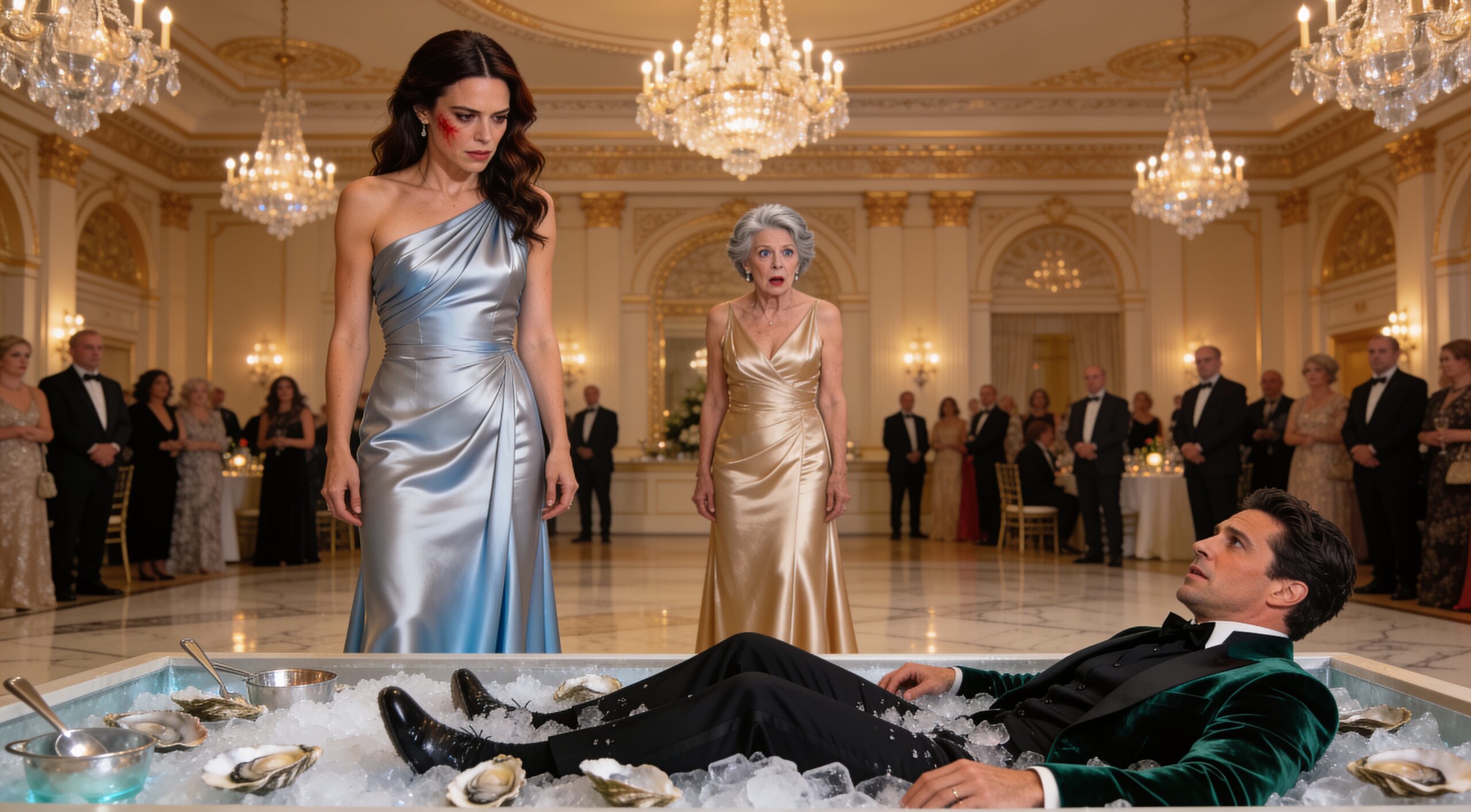
“Tell her who asked to leave first,” I said. His face tightened. “Emma, let go of me.” I told him to answer. He reached for my wrists. I shoved him off me—not toward the oyster display, not with any plan beyond creating space between us. But his heel caught near the edge of the buffet station. He staggered backward and crashed into the bed of crushed ice.
Oyster shells shifted around him. A metal serving piece clattered to the floor. The collective gasp from the crowd was almost louder than the fall. Julian lay there stunned, his dark jacket covered in melting ice. For one absurd second the entire scene looked unreal: a formal ballroom, crystal chandeliers, an elegant crowd, my cheek marked red, and my husband sprawled in a seafood display because he had refused to stand still and tell his mother one simple truth.
I looked down at him. I was angry, embarrassed, and shaking, but underneath all of that I felt something unexpected: relief. I said, “I’m done protecting you.” Then I turned to leave.
Vivian called my name before I reached the doors. Her voice had changed. “What did you mean when you said he asked to leave first?” I stopped. Julian, still climbing out of the ice, immediately said, “Mom, don’t.” Vivian looked at him as if she were seeing him clearly for the first time that night. “Don’t what?” she asked.
I told her the truth in the simplest way possible. Three weeks earlier, Julian had told me he no longer wanted the marriage. He had asked me to keep the separation private until after the gala. I had agreed. I told her that I had believed the silence was mutual. Vivian listened without interrupting. When I finished, she asked Julian whether it was true.
He tried to soften it. He said he had only told me he needed space. I repeated the exact sentence I remembered: “I don’t want this marriage anymore.” He could have denied it. He did not. Instead, he looked around at the guests and complained that we were discussing private matters in public. Vivian’s face hardened again, but this time her anger was no longer directed at me.
“You told me she was walking away from you,” Vivian said. Julian answered that things had been complicated. She told him not to hide behind that word. She repeated the story he had given her: Emma had made up her mind; Julian was trying to save the marriage; Julian did not want anyone blaming Emma because he still cared about her. It was a story carefully designed to make him look patient and wounded.
I finally understood why Vivian had been so hostile. Julian had not asked her to attack me, and nothing excused the slap. But he had handed her a false picture and then stood aside while she reacted to it. He had turned my silence into proof of his version. The very favor I thought I was doing for him—keeping our separation private—had made it easier for him to describe me any way he wanted.
Vivian asked the question that mattered most: “Why would you let me believe she did this to you?” Julian said he knew Vivian would overreact if she believed he had chosen the separation. The answer was revealing because it still made his deception sound like something he had done for everyone else. I told him that if he truly wanted to avoid an overreaction, he could have said nothing at all. He did not have to make me the villain.
For the first time that evening, Julian admitted what he had actually wanted. He said he did not want to be blamed for ending the marriage. He had spent his whole life trying to meet his family’s expectations. Vivian had always praised us as the stable couple, the example everyone else should follow. He was afraid that if he told her he wanted out for reasons he could not reduce to a dramatic betrayal, she would see him as selfish. So he let her believe the decision belonged to me.
That was the biggest reveal, and it was almost painfully ordinary. Julian had not constructed some criminal plot. He had done something smaller and more intimate: he had used my reputation to protect his own. He knew Vivian would be angry at someone, and he made sure that someone was me. He expected me to keep smiling through the gala, leave quietly later, and allow the family to remember him as the husband who tried.
Vivian looked at the mark on my cheek and said, “Emma, I was wrong to hit you.” I told her, “Yes, you were.” She seemed surprised that I did not immediately forgive her, but she did not argue. She apologized again, this time without explaining herself. I appreciated that more than I expected, but the apology did not erase the impact or the months of contempt that had led to it.
Then she turned to Julian and asked whether he had ever planned to correct the story. He hesitated too long. Finally he said he thought he would explain after the gala, once everyone had calmed down. Vivian asked, “After Emma left and everyone already believed she had abandoned you?” Julian had no answer.
I picked up my evening bag and told them both I was leaving. Julian asked me to wait so we could go home together. I said there was no reason to perform another scene for the guests. He had asked for a separation, and for the first time I was going to respect that request without carrying the shame he had attached to it.
As I walked toward the ballroom doors, the crowd moved aside. I could feel people watching, but I no longer cared what version they had heard. Behind me, Vivian asked Julian one final question: “If Emma had stayed quiet tonight, what were you planning to tell us tomorrow?” His answer came softly: that he would have said we had mutually decided to separate and that he hoped everyone would respect our privacy. Vivian asked why he had not simply said that from the beginning. Julian had no good answer because there was none.
I spent that night at a friend’s apartment. The next morning, Julian sent a long message apologizing for allowing the lie to grow. He said he had never expected Vivian to confront me physically. I believed that part. But I also told him the slap was not the only thing I needed him to understand. He had watched his mother treat me like a traitor for weeks and never corrected her because her anger was useful to him.
Over the next several days, we spoke twice, calmly and without the audience he had feared so much. Julian admitted he had been more concerned with how the separation would make him look than with how it would affect me. He did not ask to restart the marriage. I did not ask him to. Oddly, that honesty was the most respectful conversation we had had in months.
Vivian called me three days after the gala. She did not ask me to forgive her. She said she wanted me to know she had told the relatives she had spoken to that Julian—not I—had initiated the separation, and that she had been wrong to repeat a story without asking me what had happened. I told her correcting the record mattered, but so did the fact that she had put her hands on me. She said she understood and would not expect a relationship with me to return to what it had been.
A month later, Julian and I were living separately. We were not friends, but we were finally speaking honestly. There was no dramatic reunion and no public revenge. The family stopped treating me as though I had committed some unforgivable act. Vivian and I exchanged short, civil messages when necessary. Trust had not returned, but the truth no longer needed my help to stay hidden.
What stayed with me most was not the image of Julian lying in crushed ice, although I knew that would be the moment everyone remembered. It was the sentence he said before everything exploded: “Emma, not here.” For years, whenever something difficult threatened the appearance of peace, that had been the rule of our marriage. Not here. Not now. Not in front of people. Not until later.
The gala ended that rule. The truth came out in the most public, humiliating way possible, and I would never pretend that the shove or the scene was something to celebrate. But I also stopped accepting the idea that keeping the peace meant carrying someone else’s lie. When I walked out of that ballroom with a red mark on my cheek, I was not walking away because Julian’s mother had slapped me. I was walking away because I finally understood what protecting his image had been costing me.
Sometimes the moment a family calls a scandal is simply the moment the truth stops cooperating.