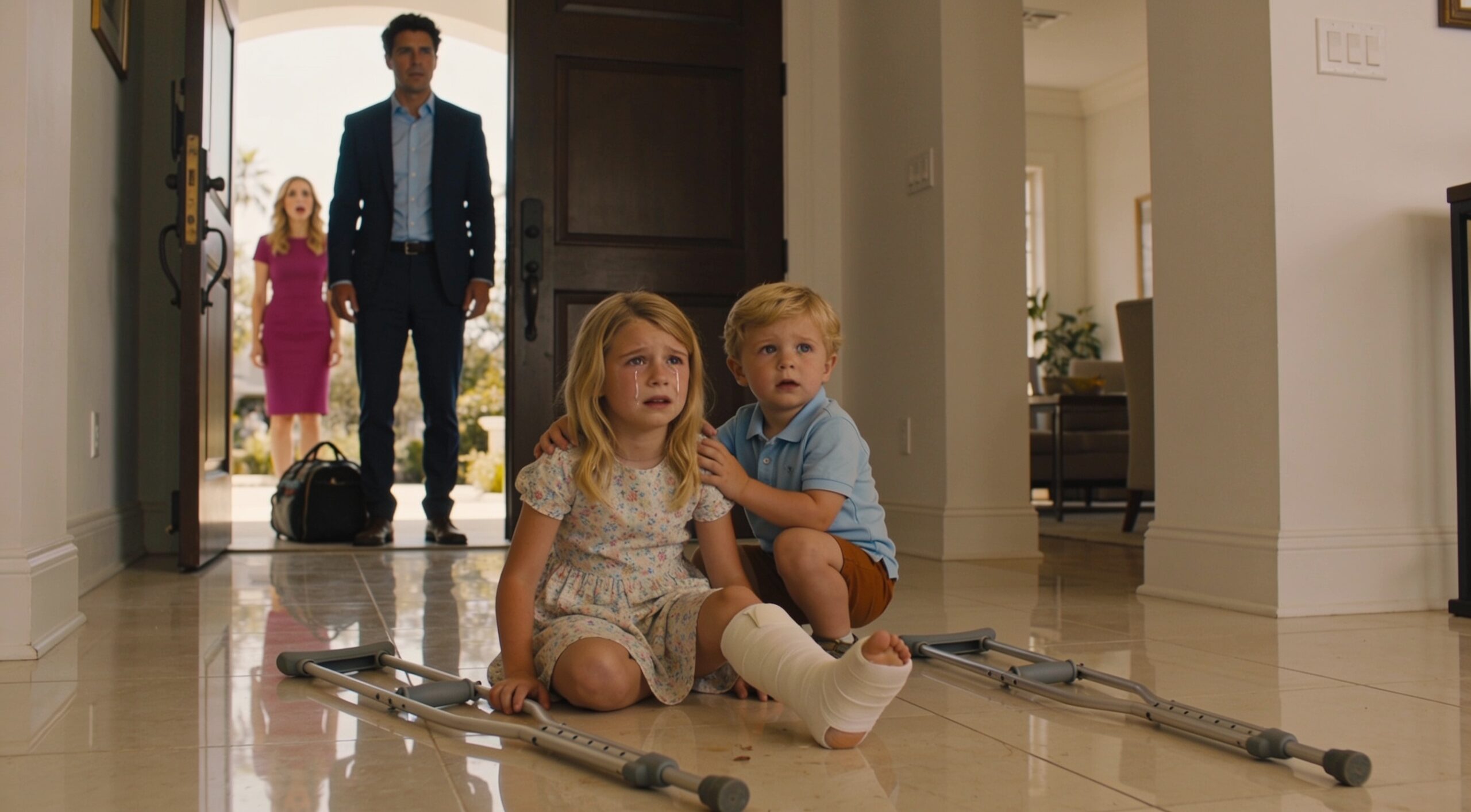
I came home a day early from a business trip and found my eight-year-old daughter crawling across the foyer.
Her baby brother was on her back.
And one of her legs was still in a cast.
I had two travel bags in my hands when I opened the front door.
For a second, I thought I was looking at some strange game.
Then I saw Lily’s face.
She was crying.
Ben was crying too.
He had both arms wrapped around her shoulders.
Lily was moving on her hands and knees across the glossy tile.
Her gray crutches were awkwardly beside her.
The thick white cast on her lower leg dragged behind.
I stopped.
“Lily?”
She looked up.
Her face changed the moment she saw me.
Not relief.
Fear.
Like she had been caught doing something wrong.
I dropped one of my bags.
“What are you doing?”
“Ben wouldn’t stop crying.”
I walked closer.
“Sweetheart, your leg.”
“I know.”
“Stop moving.”
She tried to shift Ben higher on her back.
The movement made her wince.
I crouched beside her.
“Don’t. I’ve got him.”
Ben reached toward me.
I lifted him first.
Then I looked at Lily.
She was still crying.
“Why were you carrying him?”
“I was taking him to get his cup.”
“Where is Mom?”
She hesitated.
That hesitation mattered.
Then Caroline appeared in the hallway.
She wore a dark pink dress.
Her face was tense.
Her hands were closed at her sides.
“Ryan.”
I looked at her.
“What happened?”
She stepped forward.
“I was on a call.”
I stared.
“With Lily like this?”
“No.”
She shook her head quickly.
“I didn’t know she was doing this.”
I looked back at my daughter.
“Tell me.”
Lily wiped her face.
“Mom asked me to watch Ben.”
Caroline immediately said, “From the couch.”
Lily looked down.
“He started crying.”
“So you called Mom?”
Lily shook her head.
“Why not?”
She did not answer.
I saw the crutch beside her hand.
I saw the cast.
I saw the way she was trying to make herself smaller.
“Lily.”
Her lip trembled.
“I didn’t want to bother her.”
That was when I felt something cold move through me.
My daughter had broken her ankle three weeks earlier.
The injury itself had been frightening but straightforward.
A fall.
A fracture.
A cast.
Several weeks of limited activity.
Doctors told us she would heal.
That should have been comforting.
But family life changed overnight.
Lily needed help getting dressed.
Help showering.
Help carrying school things.
Help getting up stairs.
At first, everyone handled it well.
Caroline made charts.
I moved furniture.
Ben thought Lily’s crutches were fascinating.
Then the exhaustion started.
Small frustrations.
Meals running late.
Ben crying while Lily needed help.
Work calls interrupted.
Appointments.
Laundry.
Medication.
Nothing catastrophic.
Just too much, too often.
I traveled for work occasionally.
I hated leaving during Lily’s recovery.
Caroline insisted she could manage.
“Go,” she told me. “It’s three days.”
I called constantly.
Every time, Lily said she was fine.
That should have reassured me.
Instead, looking back, it was the first warning.
Lily was never “fine” that consistently.
She was eight.
She complained when cereal got soggy.
But after breaking her ankle, she stopped complaining about anything.
I thought she was being brave.
I did not understand she was trying to become invisible.
The night before my trip, I heard Caroline talking to a friend in the kitchen.
She sounded exhausted.
“I’m okay,” she said. “It’s just harder right now.”
I walked in.
She smiled at me.
“I’m fine.”
I asked if I should cancel.
“No.”
“You sure?”
“Yes.”
What neither of us knew was that Lily had been in the hallway.
She heard more than I did.
Later, Caroline admitted exactly what she said.
“Everything got harder after Lily got hurt.”
She meant scheduling.
Work.
The household.
Her own exhaustion.
She did not mean Lily was the problem.
But children do not always hear the difference.
Lily heard:
Everything got harder after Lily got hurt.
And in her mind, that became:
I made everything harder.
That belief began changing her behavior.
She stopped asking Caroline to refill her water bottle.
She tried carrying school books while using crutches.
She waited too long before asking to go upstairs.
Once, she crawled from her room to the bathroom because Caroline was putting Ben down for a nap.
Caroline found her afterward.
“What are you doing?”
Lily said, “I’m okay.”
Caroline helped her up.
She thought it was stubborn independence.
She did not understand the reason.
Neither did I.
On the day I came home, Caroline had an important work call.
Ben was restless.
Lily was on the couch.
Caroline said, “Can you keep an eye on him for ten minutes?”
That was the mistake.
Not because an older sibling can never sit beside a toddler.
Because Lily was injured.
Because Ben was eighteen months old.
Because “keep an eye on him” is an adult responsibility when the older child cannot even move freely.
Caroline later admitted she knew that.
At the time, she was overwhelmed.
She convinced herself ten minutes was nothing.
Then Ben wanted his cup.
It was in the kitchen.
He cried.
Lily called his name.
He climbed onto her.
She tried to stand with the crutches.
She could not balance while holding him.
So she got down.
Hands.
Knees.
Cast.
Toddler.
She crawled.
That was the moment I walked in.
I picked Lily up carefully.
She wrapped her arms around my neck.
She was surprisingly light.
That made me emotional too.
She had always felt bigger somehow.
Loud.
Fast.
Everywhere.
Now she felt small.
I sat her on the couch.
Caroline came closer.
“Lily, I am so sorry.”
Lily looked away.
I gave Ben to Caroline.
Then I knelt in front of my daughter.
“For what?”
She looked confused.
“You said sorry.”
She nodded.
“What are you sorry for?”
“For making everything harder.”
Caroline inhaled sharply.
I stared at Lily.
“What does that mean?”
She looked toward her mother.
“Mom said it.”
Caroline’s face drained.
“No. Lily.”
“You said everything was harder after I got hurt.”
Caroline put one hand over her mouth.
I remembered the conversation.
I understood immediately.
She had heard it.
Not the context.
Just the sentence.
Caroline moved closer.
“I did say that.”
Lily started crying again.
Caroline sat on the floor.
“But I did not mean you make life harder.”
“You said after I got hurt.”
“Yes.”
Caroline’s voice shook.
“Because there were more appointments. More things to remember. I was tired. That was about me, Lily. Not you.”
Lily looked at her cast.
“If I didn’t get hurt, it wouldn’t be harder.”
Technically, the logic was perfect.
Emotionally, it was devastating.
I said, “Listen to me.”
She looked at me.
“You can need help every day for the next year and you still would not be a burden.”
She cried harder.
I continued.
“You do not have to make yourself useful so we will be patient with you.”
Caroline started crying too.
That was when Lily said the sentence I will remember forever.
“I thought if I helped more, Mom wouldn’t be sorry I got hurt.”
I felt tears in my eyes.
One fell before I could stop it.
I looked at Caroline.
She looked destroyed.
Not defensive.
Destroyed.
“I am not sorry you got hurt,” she said.
Lily looked confused.
Caroline corrected herself.
“I hate that you got hurt. I wish I could take the pain away. But I am not sorry that I have to help you.”
She reached for Lily’s hand.
“You are my child. Helping you is my job.”
Lily asked, “Even when you’re tired?”
Caroline cried.
“Especially then.”
I sat beside them.
For several minutes, nobody tried to fix the moment.
We just sat.
Ben played with the strap on my travel bag.
Then I asked Caroline the question that had been building inside me.
“How long has she been thinking this?”
Caroline looked at the floor.
“I don’t know.”
That answer frightened me.
We began reviewing the past few weeks.
The water bottle.
The books.
The bathroom crawl.
Lily pretending she was not in pain.
The time she refused pain medicine because she thought Caroline was busy.
One by one, ordinary moments changed meaning.
Caroline had seen independence.
I had seen bravery.
Lily had been practicing disappearance.
That night we made rules.
Not rules for Lily.
Rules for us.
Lily would never be responsible for Ben while she was injured.
Not for ten minutes.
Not for two.
If Caroline had a work call, Ben would be with another adult or in a safe supervised setup that did not depend on Lily.
If Lily needed something, she asked.
No apology.
If she was in pain, she said it.
No apology.
If she needed to use the bathroom, eat, drink, move, rest or cry, she did not wait until someone looked less busy.
And most importantly, we stopped praising her for “not needing anything.”
That one surprised me.
I realized how often adults reward children for being convenient.
“You were so good today.”
Meaning:
You asked for nothing.
“You were so easy.”
Meaning:
Your needs did not interfere with mine.
Children hear those messages.
Lily had heard them too well.
I shortened my next work trip.
Caroline rearranged part of her schedule.
We hired reliable childcare for several afternoons each week.
It was not glamorous.
It was not a dramatic family breakup.
It was logistics.
But good logistics can protect children from emotional damage adults mistakenly call resilience.
Caroline apologized more than once.
The first apology mattered.
The later ones mattered more.
She changed behavior.
That is how children learn an apology is real.
One afternoon, Lily called from her bedroom.
“Mom?”
Caroline was making dinner.
She stopped.
“Yes?”
“Can you bring my water?”
A tiny request.
Caroline smiled.
“Absolutely.”
Lily called again.
“And my book?”
Caroline laughed.
“Now you’re pushing it.”
Lily froze.
For half a second, I saw the old fear.
Caroline saw it too.
She immediately added, “I’m kidding. Which book?”
Lily smiled.
“The blue one.”
That moment showed us how careful healing needed to be.
Words do not disappear simply because adults explain them.
They leave echoes.
The cast came off several weeks later.
Lily was nervous.
The doctor said her ankle had healed well.
She would still need time before running normally.
On the way home, Lily asked, “Does this mean I can help with Ben again?”
Caroline answered before I could.
“It means you can be his sister.”
Lily thought.
“What’s the difference?”
Caroline smiled.
“You can play with him.”
“And?”
“You can make him laugh.”
“And?”
“You can teach him bad habits.”
Lily laughed.
“But you are not his parent.”
Lily nodded.
That distinction became important.
Months later, I came home from another short trip.
Same front door.
Same foyer.
Different scene.
Lily ran toward me.
No cast.
No crutches.
Ben followed behind as fast as his toddler legs allowed.
Caroline stood in the hallway.
This time her hands were not clenched.
She was smiling.
I picked Lily up.
“You’re getting heavy.”
She gasped dramatically.
“Dad!”
I laughed.
Then she leaned close and whispered:
“I ask for help now.”
I looked at her.
“Good.”
She smiled.
“Even when Mom is busy.”
From the hallway Caroline said, “Especially when I’m busy.”
We all laughed.
That is the ending I prefer to remember.
Not Lily crawling on the tile.
Not the cast.
Not my tears.
The part where a child learned that needing people is not failure.
And two exhausted parents learned that a child should never have to become easier to deserve care.