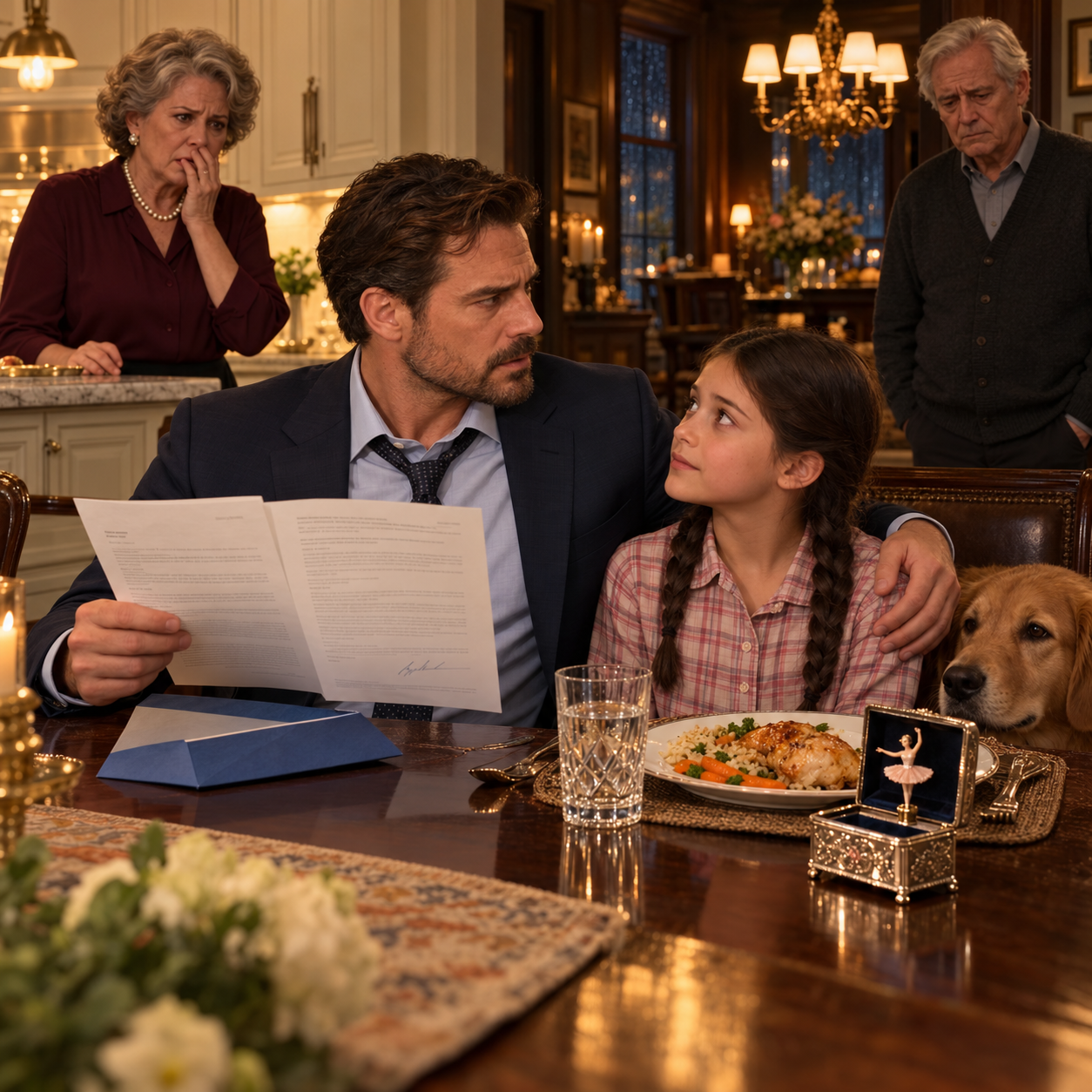
Gabriel held the second page beneath the kitchen light.
His name was printed clearly.
The signature beneath it had the familiar slant, the long tail on the final letter, even the small break between his first and last names.
Someone had practiced.
Across the room, Marlene extended her hand.
“Give me the paperwork.”
Gabriel looked at her.
“Who signed this?”
“It’s an administrative form.”
“Who signed it?”
Everett stood in the doorway, staring at the floor.
For most of Gabriel’s life, his father’s silence had seemed like patience. He was the quiet one. The reasonable one. The man who let Marlene speak because arguing supposedly made everything worse.
Now Gabriel wondered how much harm had been hidden inside that silence.
“Dad.”
Everett looked up.
“Did you know?”
Marlene stepped between them.
“Your father has nothing to do with this.”
Gabriel turned the page over.
A provider name appeared beneath the payment details.
Elm House Family Support Services.
He had never heard of it.
“Who are these people?”
Nobody answered.
He took out his phone and photographed both pages.
Marlene moved toward him.
“Don’t start sending private family information around.”
He stepped back.
“This is addressed to me. It concerns my daughter.”
“You’re making assumptions.”
“Then tell me when these people came to the house.”
She folded her arms.
Gabriel waited.
“What days? Who worked with Amelia? What services did they provide?”
From upstairs came the faint sound of the music box.
All three adults looked toward the ceiling.
Amelia was awake.
Gabriel lowered his voice.
“This conversation is finished for tonight.”
Marlene exhaled as though she had won something.
Then he added, “You and Dad will stay somewhere else.”
Her face hardened.
“You’re throwing your parents out?”
“I’m making sure Amelia wakes up in a house where she isn’t afraid to sit down.”
“We’ve kept this family together since Nora died.”
Gabriel looked at the letter in his hand.
“You can pack what you need for a few nights. We will arrange the rest later.”
Everett opened his mouth.
For once, Gabriel hoped his father would say something useful.
Instead, he asked, “Where are we supposed to go?”
“A hotel. Leah’s house. You have choices.”
He thought of Amelia looking toward the dining room before answering a question.
“She didn’t.”
His sister, Leah, arrived twenty minutes later to collect Bryce and Theo.
Gabriel met her at the door.
“Something happened tonight. I need to explain it to you tomorrow, when the children aren’t here.”
She searched his face.
“Is Amelia okay?”
“She’s upstairs. I’m staying with her.”
Behind Leah, Marlene came down the stairs carrying an overnight bag.
“Your brother has decided we’re criminals.”
Leah looked from her mother to Gabriel.
“What?”
“I’ll call you in the morning,” Gabriel said.
Bryce appeared beside the hallway table, clutching his backpack. Theo followed, rubbing his eyes.
Neither boy looked at their grandmother.
As Leah helped Theo into his coat, Bryce lingered.
“Uncle Gabe?”
Gabriel turned.
The boy’s voice was barely audible.
“I gave her my bread sometimes.”
Gabriel felt his chest tighten.
“Amelia?”
Bryce nodded.
“When Grandma said she couldn’t have more.”
Marlene made an impatient sound.
“Bryce, that is enough.”
The boy’s shoulders rose.
Gabriel moved closer, keeping his voice gentle.
“You’re not in trouble.”
Bryce looked toward the staircase.
“Grandma said if we told you, you’d send Amelia somewhere else because she was too much work.”
Leah went still.
“What did you say?”
Bryce began to cry.
“I didn’t want her to go.”
Gabriel put a hand on his nephew’s shoulder.
“You were trying to help her. This was never your responsibility.”
Leah pulled both boys close.
When she looked at her mother again, her expression had changed completely.
“Get in the car, boys.”
“Leah—”
“No, Mom. You can arrange your own ride.”
Amelia was sitting upright when Gabriel returned to her room.
The music box lay open on her blanket.
“Is Grandma leaving because of me?”
He sat on the edge of the bed.
“Grandma is leaving because of choices she made.”
“Was I supposed to stay on the floor?”
“No.”
She studied his face.
“Even when you weren’t home?”
“Especially then.”
Her fingers rested on the little ballerina.
For a while, neither spoke.
Then Amelia whispered, “She said Mommy left me money because she knew I would be expensive.”
Gabriel’s breath caught.
Nora had spent the last months of her illness planning for Amelia’s future. She had worried about school support, patient professionals, and making sure their daughter could ask for help without feeling like a burden.
She had never called her expensive.
Gabriel took Amelia’s hand.
“Mommy left you money because she loved you and wanted you to have what you needed.”
“Grandma said every time I needed help, there was less for everyone else.”
“That money was set aside for you. Needing help doesn’t take away your place in this family.”
Amelia looked down.
“Did you know I stopped going to see Ms. Patel?”
Gabriel stared at her.
Her occupational therapist.
Marlene had told him the sessions had ended because Amelia had met her current goals.
“No, sweetheart. I thought you’d finished.”
“Grandma said I should be able to do everything by myself now.”
He fought the urge to ask ten questions at once.
Instead, he asked one.
“Do you miss going?”
Amelia nodded.
“She let me try again when I got things wrong.”
Gabriel stayed beside her until she fell asleep.
This time, he left her door open.
At eight the next morning, he called Westbridge Trust Company.
He asked for the officer responsible for Amelia’s account.
When a woman named Denise Warren came on the line, he read her the reference number from the letter.
“I need to dispute an authorization,” he said. “The signature is not mine.”
Her tone became careful.
“Do you have the original document?”
“Yes.”
“And are you saying the services described were not provided?”
“To my knowledge, nobody from this organization has ever worked with my daughter.”
Denise asked him to send copies through the company’s secure channel. She explained that she would flag the disputed payments, begin an internal review, and arrange preservation of the relevant records.
Gabriel wrote everything down.
Before they ended the call, he asked, “Is this the first payment?”
There was a pause.
“No, Mr. Hart.”
His pen stopped.
“How many?”
“Four quarterly disbursements to this provider.”
Each for $18,450.
Seventy-three thousand eight hundred dollars.
For a moment, Gabriel could hear only the refrigerator humming.
Then Amelia appeared in the kitchen doorway.
“Can I have cereal?”
He covered the phone.
“You can.”
“At the table?”
He closed his eyes briefly.
“Yes, sweetheart. At the table.”
Denise sent the records that afternoon.
There were invoices for home-based developmental support, supervised activities, and respite care.
There were attendance sheets.
Progress summaries.
Repeated authorizations bearing Gabriel’s copied signature.
Some statements described sessions on days when Amelia had been at school.
One claimed a provider had spent six hours helping her with community activities on a Saturday Gabriel remembered clearly.
He had taken Amelia to the aquarium that day.
He still had the photograph of her standing beneath the blue light of the jellyfish tank.
The invoice sat beside that photograph on his desk.
He stared at the two documents until his eyes burned.
The payments had gone directly to Elm House Family Support Services.
Its mailing address was a box at a shipping center near Marlene’s old apartment.
Gabriel called an attorney, who helped him organize the records and make a report. He supplied the documents he had and left the investigators to establish where the money had gone.
For the first time in years, he canceled every trip on his calendar.
His business partner offered to cover the following week.
Gabriel thanked him.
He did not say he would make it up by working twice as much later.
Leah arrived that evening without the boys.
She placed her phone on the kitchen table.
“Mom sent me this.”
The message read:
Your brother is overwhelmed. Please do not encourage his suspicions. Everything I did was for the children.
Leah rubbed her forehead.
“Last year, she told me she’d found a private education fund that could help with Bryce’s tuition.”
Gabriel looked up.
“What fund?”
“She wouldn’t give me much detail. She said an old friend had arranged it and didn’t want attention.”
“How much?”
Leah told him.
He wrote the amount down.
She watched him.
“Gabe. Was that Amelia’s money?”
“I don’t know yet.”
Tears filled her eyes.
“I thought someone was helping us.”
He pushed a box of tissues toward her.
“You didn’t submit the invoices.”
“No. But if that’s where it came from, I want to know. I’ll provide everything.”
She took a breath.
“And the boys won’t be staying with Mom again.”
Gabriel glanced toward the living room.
Amelia was curled beside Biscuit, reading aloud to him. Every few sentences, she paused to show the dog a picture.
Leah watched her too.
“I should have asked why she got so quiet.”
Gabriel nodded.
“So should I.”
Everett came to the house three days later.
Gabriel met him outside.
His father was holding a brown document envelope.
“Your mother doesn’t know I’m here.”
“What’s in it?”
“Copies.”
Gabriel did not take it immediately.
“Copies of what?”
Everett swallowed.
“The invoices. Some bank statements. I kept the files when I helped her print them.”
“You helped?”
His father looked older than he had a week earlier.
“I entered the dates.”
Gabriel stood very still.
“You recorded sessions that never happened?”
“Yes.”
“And watched Amelia eat on the floor?”
Everett’s eyes filled.
“Yes.”
The second answer was harder to hear.
There were no excuses in it, but it arrived years too late to be called courage.
“Why?” Gabriel asked.
“Your mother said we deserved something for the time we spent here.”
“You could have discussed payment with me.”
“I know.”
“You could have told me you were tired.”
“I know.”
“You could have fed her at the table.”
Everett lowered his head.
Gabriel took the envelope.
“I’m giving this to the attorney. You need to tell the investigators what you just told me.”
“I will.”
His father glanced toward the house.
“Can I see her?”
“Not today.”
Everett nodded.
For once, he did not ask Gabriel to make his disappointment easier.
The review took weeks.
Elm House had been created and controlled by Marlene. The paperwork described services it had never provided to Amelia.
Financial records showed that the money had paid down personal debt, funded purchases, and covered some of the nephews’ expenses.
Everett’s records helped establish how the invoices had been assembled.
Marlene had also concealed correspondence and intercepted requests for clarification.
That explained some of it.
It did not explain away the fact that Gabriel had accepted summary emails instead of reading the underlying statements. It did not excuse his decision to let his mother become the main point of contact for almost everything involving his child.
He changed those arrangements.
Then he kept checking them.
Marlene left messages.
At first, she said she could explain.
Then she said Gabriel was destroying the family.
Finally, she left one that he listened to only once.
“You know how much patience Amelia requires. You weren’t here. I was.”
Gabriel saved it with the other records.
He did not play it for his daughter.
Amelia began seeing Ms. Patel again.
At their first meeting, Gabriel sat in the waiting room with a notebook and a list of questions.
When the session ended, Ms. Patel told him that support was something to adjust to Amelia’s needs, not a privilege to remove when an adult became frustrated.
He wrote that down.
He also arranged for Amelia to speak with a child therapist.
Some days, she wanted to talk afterward.
Other days, she wanted a milkshake and silence.
He learned to accept both.
One afternoon, she asked him to look inside her school backpack.
A drawing had been folded into the smallest pocket.
It showed their dining room.
Four people sat at the table.
A little girl sat beyond the doorway beside a dog.
Gabriel stared at it.
“When did you draw this?”
“A while ago.”
“Did you want me to see it?”
She nodded.
“Grandma said you had important papers in your suitcase and my pictures would make a mess.”
Gabriel laid the drawing flat.
He wanted to tell her she could always tell him anything.
But she had tried.
So he said something else.
“I’m sorry I didn’t notice.”
Amelia touched the corner of the page.
“Can I draw another one?”
“Of course.”
“Not over this one.”
“No,” he said. “We can keep this one too.”
Her birthday came before the case was resolved.
Gabriel asked whom she wanted to invite.
“Bryce and Theo.”
He waited.
“And Aunt Leah.”
“Anyone else?”
“Ms. Patel says I can invite a friend without inviting the whole class.”
“You can.”
Amelia considered that carefully.
“Then Lucy.”
They decorated the dining room with paper stars.
Leah brought cupcakes. Bryce helped Theo tape the stars to the wall, and Biscuit spent most of the afternoon hoping someone would drop frosting.
When it was time to eat, Amelia hovered behind a chair.
Gabriel noticed but did not pull it out for her.
“Which seat do you want?”
She looked around the table.
Then she chose the one near the window.
The others sat down.
Halfway through lunch, Theo knocked over his juice.
He froze.
So did Amelia.
Gabriel reached for a towel.
“Could someone lift the paper stars away from the puddle?”
Bryce moved them. Leah fetched another cloth.
The spill was cleaned up.
Lunch continued.
A few minutes later, Amelia leaned toward her cousin.
“You can have more juice,” she whispered.
Gabriel heard her.
He kept passing the sandwiches.
There was no single day when everything became all right.
Marlene faced criminal proceedings over the false claims and forged authorizations. Everett cooperated and faced consequences for his role as well.
The financial recovery was slower than Gabriel wanted. Some money was recovered early; the remainder became part of a longer restitution process.
He kept the adult details away from Amelia.
When she asked whether her grandmother was in trouble because of the dinner, he answered carefully.
“Grown-ups are looking at choices she made about your care and your money.”
“Because I told you?”
“Because she made those choices.”
Amelia thought about that.
Then she asked whether they still had enough for her sessions.
“Yes.”
“And Biscuit’s food?”
Gabriel smiled through the ache in his chest.
“Yes. Biscuit is covered.”
She nodded, satisfied for the moment.
One evening, months after Gabriel came home early, a blue envelope arrived from Westbridge.
Amelia saw it on the counter.
Her expression changed.
Gabriel picked it up.
“Would you like to know what it is?”
She nodded.
They sat together at the kitchen table.
He opened the envelope and explained the statement in simple terms: money set aside for her, expenses that had been checked, people responsible for keeping accurate records.
“Can I ask about it when I’m older?”
“You can ask now. And when you’re older.”
“Even if the questions are hard?”
“Especially then.”
She leaned closer to inspect the page.
After a while, she lost interest and went to find her art supplies.
Gabriel remained at the table, finishing the statement himself.
He read every page.
That Friday, he came home at five-thirty.
No surprise flight. No suitcase.
Just groceries and a message from Amelia asking whether he had remembered strawberries.
He had.
She met him in the hallway.
“Daddy, I need to show you something.”
He set the bags down.
“Show me.”
She led him into the dining room.
A new drawing stood beside the silver music box.
In it, Amelia sat at the table near the window. Gabriel sat beside her. Leah, Bryce, and Theo filled the other chairs, and Biscuit lay underneath with an enormous smile.
The sixth chair was empty.
Gabriel pointed to it.
“Who’s that one for?”
“Someone unexpected.”
He looked at her.
“Mommy said tables should have room.”
“Yes,” he said quietly. “She did.”
Amelia opened the music box.
The ballerina began to turn.
Then she closed it again.
“Actually, I want to tell you what happened at school first.”
Gabriel pulled out his chair.
Amelia sat in hers without looking toward the doorway.
And he listened.