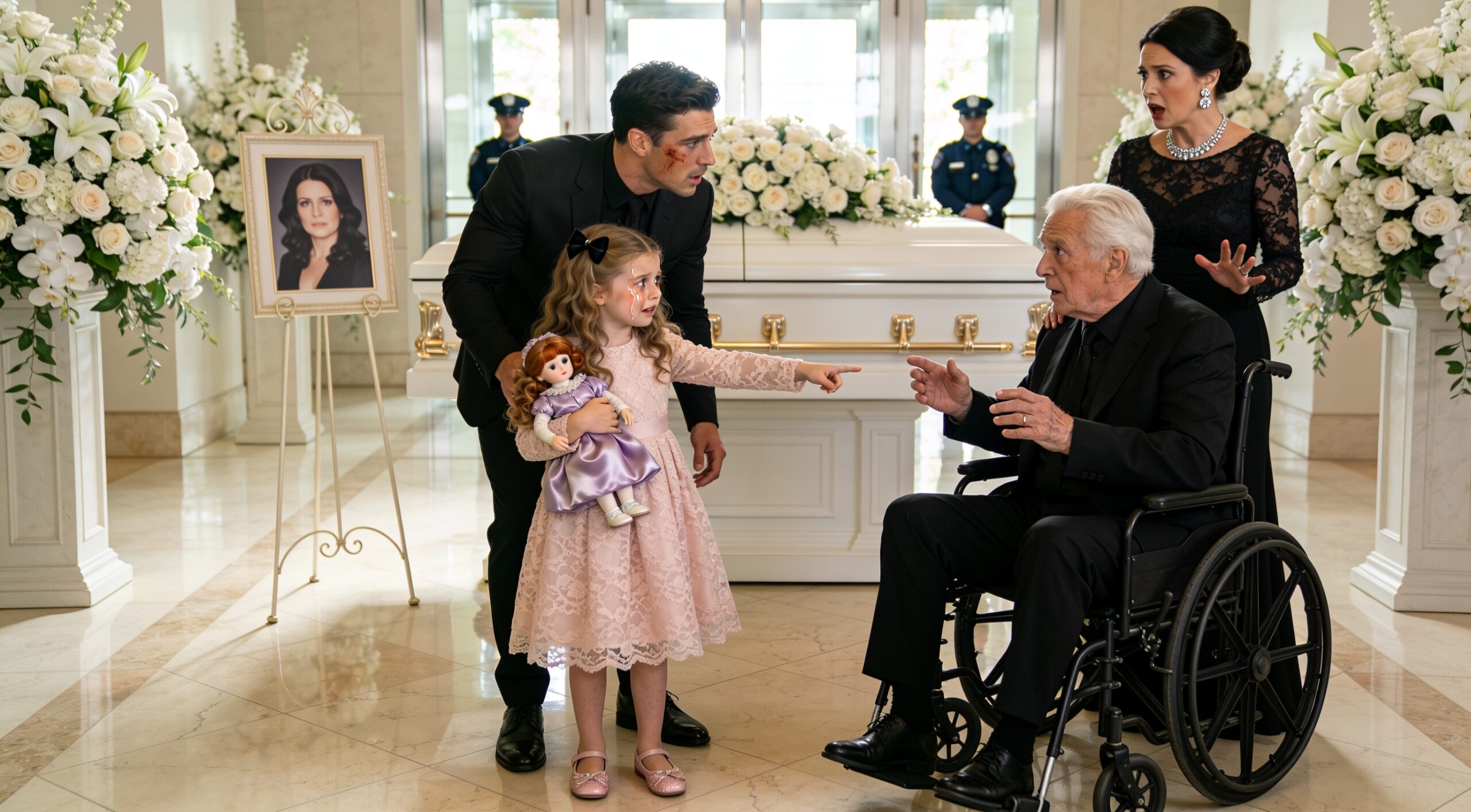
My daughter was standing beside her mother’s casket when she pointed at her grandfather and screamed.
That is the moment I remember most clearly from Amelia’s funeral.
Not the flowers.
Not the white casket with gold-colored handles.
Not the framed photograph that made my chest tighten every time I looked at it.
Sophie.
Seven years old.
Tears running down her face.
Her porcelain doll trapped against her ribs with one arm.
Her other hand pointing straight at Richard Vale.
“You told me Daddy was leaving me!”
The entire room froze.
Richard sat in his wheelchair several feet away.
He lifted both hands as if he could calm the situation through posture alone.
“Sophie, sweetheart—”
“No!”
Her voice cracked.
I had never heard my daughter interrupt an adult that way.
I had never seen her that frightened either.
I stood behind her in a black suit, feeling the bruise along my cheek tighten every time my jaw clenched.
Two police officers remained near the glass doors.
Their presence was already humiliating enough.
Now it felt almost irrelevant.
This funeral had been falling apart long before Sophie spoke.
Amelia and I had been married for nine years.
We loved each other.
That is not the same as saying our marriage was easy.
During the final year of her life, we had separated for several months.
People later treated that separation as if it explained everything.
It did not.
We were tired.
We were frightened.
We were raising a child while dealing with a future neither of us understood.
We hurt each other.
Then we started trying again.
Amelia moved back home.
We began counseling.
We stopped pretending love automatically made us good at communicating.
Richard never forgave me for the months I had been gone.
He believed I abandoned his daughter when she needed me.
There were nights when I believed that too.
Amelia did not.
At least not by the end.
She told me once, “We both broke things. We both have to stop deciding which person broke more.”
That was Amelia.
Even when she was angry, she hated scorekeeping.
Richard did not.
He kept score.
Every argument.
Every night I slept somewhere else.
Every holiday during the separation.
Every time Sophie asked why Daddy was not staying at home.
To Richard, our reconciliation came too late.
When Amelia died, his anger suddenly had nowhere to go.
So it came toward me.
The morning of the funeral, he told me I should not sit in the front row.
I thought he was joking.
“You’re serious?”
“This is her family’s service.”
“I’m her husband.”
“You were barely acting like one six months ago.”
Margaret tried to stop him.
“Richard.”
He waved her off.
I should have walked away.
Instead, I argued.
Another adult relative joined in.
Voices rose.
Someone grabbed my arm.
I pulled away.
A hand caught my face during the confusion.
That was where the bruise came from.
Funeral staff called police.
By the time everyone settled down, two officers remained near the entrance to prevent another confrontation.
It was embarrassing.
But I thought the worst part of the day had already happened.
I was wrong.
Sophie had watched more than I realized.
She stood near the casket holding the lavender doll Amelia had given her.
The doll had brown hair, a soft painted face, and a purple dress.
Sophie rarely took it out of her bedroom.
That morning she refused to leave home without it.
I did not ask why.
I should have.
Before the service began, Richard called Sophie over.
I saw them talking.
I assumed he was comforting her.
He was her grandfather.
He loved her.
I had no reason to imagine anything else.
Later I learned exactly what he told her.
He said I was overwhelmed.
He said I needed time.
He said after the funeral Sophie would stay with him and Margaret until “everyone knew what came next.”
Those words might sound gentle coming from an adult.
To a grieving seven-year-old, they meant something else.
Your mother is gone.
Now your father is going too.
Sophie asked if I knew.
Richard told her the adults were handling it.
She asked when she could go home.
He said, “We’ll see.”
That was enough.
For the next hour, Sophie carried the fear silently.
She stood through prayers.
She stood beside her mother’s casket.
She listened to adults tell stories about Amelia.
And she believed that when the funeral ended, she would not be leaving with me.
I did not know any of that.
Then, just before people began moving toward the reception room, Richard said something to Margaret about taking Sophie with them.
Sophie heard him.
That was when she broke.
“You told me Daddy was leaving me!”
I stepped forward.
Margaret immediately became defensive.
“Richard was only trying to give her stability.”
I looked at her.
“Did you know he told her this?”
She hesitated.
That hesitation answered me.
“You knew.”
“I knew he had spoken with her.”
“Did you know he told her she was not going home with me?”
“Nathan, look at today.”
She gestured toward my bruised cheek.
Toward the officers.
Toward the funeral room.
“You cannot pretend everything is normal.”
“I am not pretending anything is normal.”
“Then understand why he is worried.”
I crouched beside Sophie.
Her hands were shaking around the doll.
“Sweetheart, look at me.”
She did.
“You are coming home with me.”
Her mouth opened.
“Really?”
“Yes.”
Richard said my name.
I ignored him.
Sophie threw her arms around my neck.
I held her.
That should have been the end.
It was not.
Sophie pulled away and looked at Richard.
“You lied about Mom.”
Richard’s face changed.
“What do you mean?”
“You said Mom would want me with you.”
Margaret looked at him sharply.
I stood.
“You told her Amelia wanted that?”
Richard’s jaw tightened.
“I told her Amelia wanted her safe.”
“That is not the same thing.”
“You think you are safe right now?”
His eyes moved toward the bruise on my face.
I understood what he was doing.
He was using the chaos of that morning as proof of the story he had already decided.
I said, “Whatever you think of me, Amelia never told you to take Sophie away from me.”
Richard did not answer.
Then Sophie spoke.
“Mom told me something.”
Everyone looked at her.
She lifted the lavender doll.
“She gave me this.”
I knew that.
But I did not know why.
Sophie looked at the doll as she talked.
“Mom said when I miss her, I should hold Violet.”
Violet.
That was the doll’s name.
“She said Violet can’t talk back, so I have to remember the words myself.”
My throat tightened.
“What words?”
Sophie looked at me.
“She said, ‘You still have your dad.’”
Nobody moved.
Sophie continued.
“She said even if grown-ups fight, I don’t have to pick people.”
Margaret covered her mouth.
Richard stared at the floor.
I felt something inside me collapse.
Amelia had known.
Not that she was about to die.
Not exactly.
But she knew our family was fragile.
She knew Sophie had heard arguments.
She knew Richard blamed me.
She knew our daughter might one day feel caught between adults who all claimed to love her.
So Amelia had given her a promise simple enough for a child to carry.
You do not have to choose.
You still have your dad.
I looked at Richard.
“You told her the opposite.”
His face tightened.
“I was trying to protect her.”
“From me?”
“From instability.”
“What instability?”
“You and Amelia were separated.”
“We reconciled.”
“For how long?”
The question hit hard.
I knew what he meant.
We had been back together only a few months before Amelia died.
To Richard, that was not enough time to prove anything.
I said, “Long enough for Amelia to tell our daughter I was still her father.”
Richard looked toward the casket.
His anger changed.
For the first time that day, I saw something underneath it.
Fear.
Not fear of me.
Fear of losing Sophie.
Amelia had been his daughter.
Now she was gone.
Sophie was the closest piece of her he had left.
Richard had convinced himself that keeping Sophie close was protection.
Maybe part of him even believed Amelia would have chosen that.
But belief is dangerous when grief turns it into certainty.
I asked him one question.
“If Amelia wanted Sophie removed from my care, why didn’t she tell me?”
Richard said nothing.
“Why didn’t she put it in writing?”
Nothing.
“Why did she tell Sophie she still had me?”
His eyes filled with tears.
Margaret sat beside him.
“Richard.”
He shook his head.
“I couldn’t lose both of them.”
There it was.
The truth.
Not a legal plan.
Not a hidden document.
Not a secret instruction from Amelia.
A grieving father who could not bear the idea of his granddaughter leaving the funeral with a man he still resented.
Richard looked at Sophie.
“I was scared.”
She did not respond.
“I thought if you went home with your dad, I would barely see you.”
Sophie hugged the doll.
“You could ask.”
The simplicity of it almost broke me.
You could ask.
Richard had built an entire conflict around a conversation he never had.
He had not asked me whether Sophie could visit.
He had not asked what our plans were.
He had not asked what Amelia and I had agreed before she died.
He had simply assumed that if he did not take control, he would lose another person.
Margaret began crying.
“I should have stopped him.”
I looked at her.
“Yes.”
She nodded.
No excuse.
No argument.
Just yes.
That mattered.
The police officers stayed near the door.
One of them quietly asked whether everyone was calm enough to continue the service.
I said yes.
Richard said yes.
We finished the funeral.
Not perfectly.
There is no perfect way to finish a funeral after a seven-year-old exposes the adults around her.
But we finished it.
Sophie sat beside me.
The lavender doll stayed in her lap.
Richard and Margaret sat on the other side of the aisle.
When the final prayer ended, Sophie did not ask where she was going.
She already knew.
Home.
With me.
That evening, I made her grilled cheese because neither of us wanted real food.
She put Violet on the kitchen table.
For several minutes we said nothing.
Then Sophie asked, “Can Grandpa still come over?”
I stared at her.
“Do you want him to?”
“Yes.”
“Then yes.”
That was another lesson she taught me.
Protection did not have to mean retaliation.
I could set boundaries with Richard without making Sophie choose.
Exactly what Amelia had wanted.
The next few weeks were difficult.
Richard apologized.
Not immediately.
At first he apologized like adults often do when they are still defending themselves.
“I’m sorry you misunderstood.”
“I’m sorry things became emotional.”
I rejected both.
Finally, one afternoon, he looked at Sophie and said, “I told you something I had no right to decide. I made you afraid your father was leaving. I was wrong.”
Sophie nodded.
Then she asked, “Are you still mad at Dad?”
Richard looked at me.
“Sometimes.”
I almost laughed.
Sophie frowned.
“Mom said grown-ups can be mad and still be family.”
Richard began crying.
So did I.
Months later, Sophie still slept with Violet beside her pillow.
Sometimes she brought the doll to Richard’s house.
Sometimes she left it home.
The first time she forgot it overnight, I took that as a good sign.
The promise had moved out of the doll.
It was living inside her now.
I still think about the funeral.
The white flowers.
The casket.
The police near the doors.
The bruise on my cheek.
Richard’s hands raised in defense.
Margaret’s shock.
But most of all I remember a seven-year-old girl pointing at a room full of adults and refusing to let grief decide her life for her.
Amelia’s last gift was not the doll.
It was the sentence Sophie carried with it.
You do not have to choose.
And finally, the adults listened.