My son walked into my penthouse with a woman on his arm and spoke to me as though I were the guest.
I remember that sentence because of how calm he sounded.
“Mom, we need to settle when you’re moving.”
No shouting.
No hesitation.
Just certainty.
Michael was forty-one years old.
Old enough to know the difference between permission and ownership.
Old enough to know that a key does not become a deed simply because you carry it long enough.
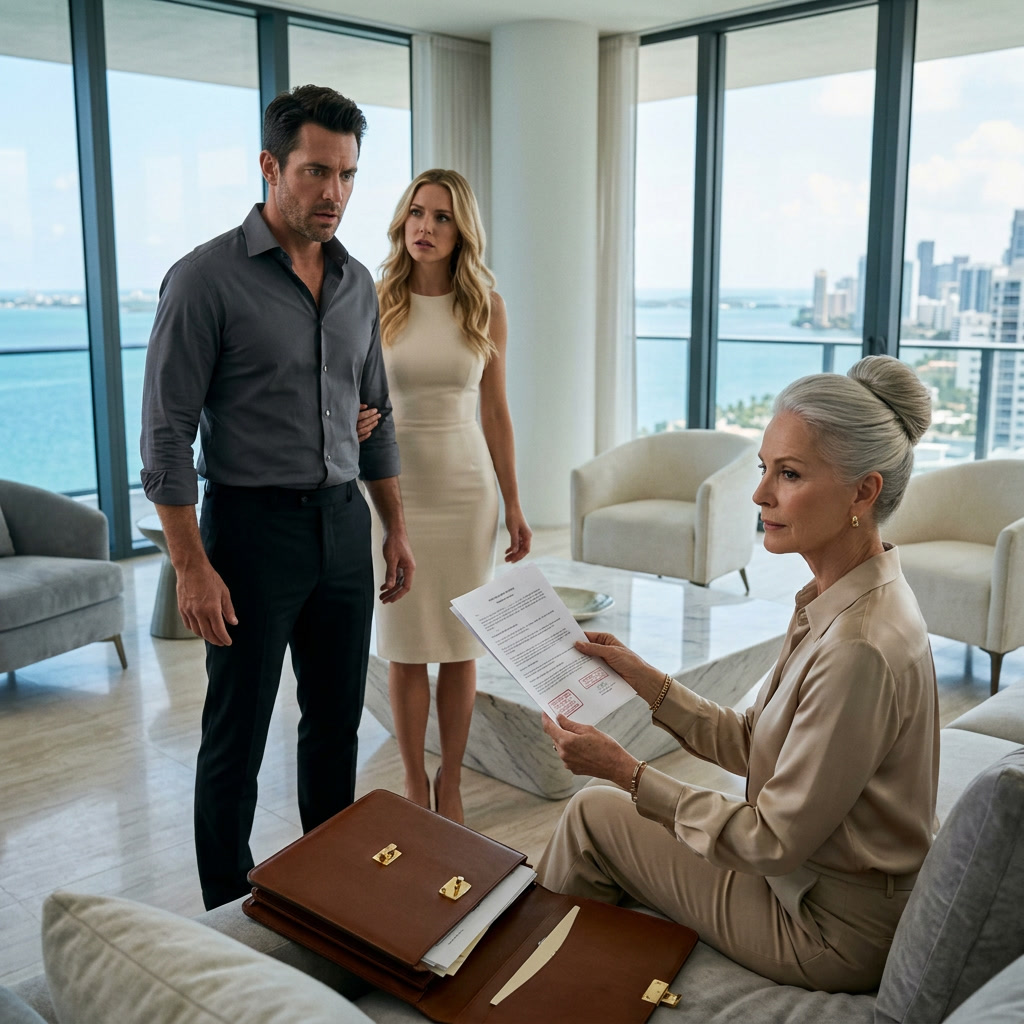
Madison stood beside him in a cream dress, one hand wrapped around his arm.
She was thirty, intelligent, polished, and visibly uncomfortable the moment I asked the simplest possible question.
“Moving where?”
Michael sighed.
“Don’t do this.”
That was when I knew he had not told her the entire truth.
The penthouse had been mine for almost twelve years.
I bought it after selling the suburban house where Michael and his sister grew up.
At the time, everyone thought I would hate apartment living.
I did not.
I loved waking up to light pouring through the glass.
I loved watching the water change color before storms.
I loved being able to lock the door, leave for three weeks, and return without worrying about a yard or an empty house sitting at the end of a quiet street.
Michael worked downtown.
His commute from his own place was terrible.
So when he had late meetings, I let him stay.
Eventually I gave him a key.
It was practical.
He checked deliveries when I traveled.
He watered the plants.
He handled maintenance appointments if I was away.
He never paid rent.
I never asked him to.
He was my son.
At first, the arrangement worked exactly as intended.
Then language started shifting.
Michael would tell friends, “I’m at our place downtown.”
I noticed.
I did not correct him.
Later, he called it “the family penthouse.”
That was not technically wrong.
It belonged to a member of the family.
I still did not correct him.
Those small decisions mattered more than I realized.
Silence can accidentally become permission when someone benefits from misunderstanding it.
When Michael started dating Madison, I saw him less often.
That was normal.
I liked her.
She was direct, energetic, and seemed genuinely serious about him.
The first time we had dinner together, she asked about my travel.
I told her I loved it.
She smiled.
“That’s probably why Michael got so comfortable with the penthouse.”
I laughed.
“He certainly did.”
She laughed too.
At the time, I thought we were making the same joke.
We were not.
Several months later, I returned from a trip and found paint samples on my kitchen counter.
I called Michael.
“What are these?”
“Madison likes the warmer one.”
“For what?”
“The guest room.”
I paused.
“What about the guest room?”
He laughed.
“Nothing is happening without talking to you.”
That should have been the moment I asked more questions.
Instead, I said, “Good.”
A week later, the building manager called.
He was polite.
Almost too polite.
“Ms. Grant, I wanted to confirm whether you approved Michael’s request to discuss a long-term resident update.”
I sat down.
“What long-term resident update?”
There was a pause.
“He mentioned that Madison may be moving in.”
My first feeling was not anger.
It was confusion.
Michael had never asked me.
I told the manager not to change anything.
Then I called my son.
He did not answer.
That evening he texted.
Can we talk when you’re back?
I was already back.
I replied with one sentence.
Bring Madison tomorrow.
He called immediately.
“Why does Madison need to be there?”
“Because apparently she is moving into my home.”
Silence.
Then, “Mom, it’s complicated.”
“No. Ownership is usually simple.”
He became defensive.
“You always said this place would stay in the family.”
“Yes.”
“I am family.”
“Yes.”
“So why are you acting like I’m some stranger trying to steal it?”
I did not answer the accusation.
I said, “Tomorrow. Four o’clock.”
Before they arrived, I took the brown leather portfolio from a cabinet in my office.
It contained records I rarely needed.
Closing papers.
Building documents.
Insurance material.
And the occupancy agreement Michael had signed eight years earlier.
The agreement was not dramatic.
I had not drafted it because I distrusted him.
The building required written acknowledgement before I gave him unrestricted resident access.
It stated that I remained the owner.
Michael’s use was permissive.
He could not represent himself as having ownership authority.
He had signed it without complaint.
I doubted he had read it again since.
At four fifteen, the glass doors opened.
Michael entered first.
Madison was beside him.
She held his arm.
He looked prepared.
She looked hopeful.
That hurt.
Not because I disliked her.
Because I knew immediately that she had arrived expecting a different conversation.
Michael did not sit.
“Mom, we need to settle when you’re moving.”
I looked at Madison.
She watched me carefully.
I asked, “Moving where?”
Michael’s face tightened.
“You said you wanted to travel more.”
“I do.”
“You said you might spend part of the year in California.”
“I might.”
“So Madison and I thought—”
I interrupted.
“You thought I was giving you my home?”
Madison looked at Michael.
He answered quickly.
“You always said it would stay in the family.”
I nodded.
“It is staying in the family. I am family.”
Madison shifted her weight.
“Michael told me you were planning to transfer it.”
I looked at her.
“No.”
The word was enough.
Her expression changed.
Michael said, “Not yet.”
“Not ever, as far as I have decided.”
He stared at me.
“You’re doing this because you’re angry.”
“No. I am angry because you did this without asking.”
I reached for the portfolio.
Michael saw it.
That was the first moment he looked afraid.
I opened the leather flap.
Madison watched.
I removed the ownership record.
The red stamps and official seals looked more dramatic than the language itself.
I held it up.
“This is the current ownership record.”
Michael exhaled.
“We know your name is on it.”
Madison turned toward him.
“We?”
That was important.
He had told her the transfer was essentially complete.
Not that the apartment remained clearly and entirely mine.
I set the first document down.
Then I removed the second.
Michael recognized it before Madison did.
His face changed.
“What is that?” she asked.
I answered.
“The agreement Michael signed when I gave him full-time access.”
Michael said, “Mom.”
I kept going.
“It states that his access is temporary and that ownership remains with me.”
Madison looked at him.
“You signed that?”
He did not answer immediately.
“Michael?”
“Yes.”
The room became very quiet.
She let go of his arm.
“You told me this apartment had been transferred to you years ago.”
“I said it was effectively mine.”
“No. You said it was yours.”
Michael looked at me.
“This is what you wanted, right? To embarrass me?”
I almost laughed.
Not because anything was funny.
Because accusation was easier for him than admission.
“I asked Madison here because you involved her.”
He said nothing.
“You made plans with her inside a story about my property. She deserved to hear the correction in the same room.”
Madison walked toward the window.
She stared outside.
For several seconds, she did not speak.
Then she asked, “When were you going to tell me?”
Michael said, “I thought Mom would come around.”
I stared at him.
That sentence explained everything.
He had not misunderstood.
He had gambled.
He believed if he acted as if the transfer were inevitable, I would eventually surrender to the expectation.
Maybe he thought I would be embarrassed to say no.
Maybe he thought age would make me easier to move.
Maybe he simply confused generosity with weakness.
Madison turned back.
“Why did you tell me she wanted to retire somewhere else?”
Michael hesitated.
I looked at him.
That was the part I had been waiting for.
Over the previous months, I had heard fragments from neighbors and building staff.
Michael had been telling people I was “downsizing.”
That I no longer wanted the responsibility.
That the penthouse was too much for me.
None of it came from me.
I traveled because I loved traveling.
I lived in the penthouse because I loved living there.
He had transformed my independence into a story about decline.
That hurt more than the ownership lie.
I told Madison.
“Michael has also been telling people I am ready to move because this place is becoming too much for me.”
Her face changed.
She looked at him.
“You told me your mom asked you to take over because she was tired of managing everything.”
Michael rubbed his forehead.
“I was trying to simplify it.”
“For who?”
Nobody answered.
Madison’s voice became quieter.
“You could have just told me you wanted this place.”
Michael looked at the floor.
That was the first honest moment.
“I wanted you to think I had something solid.”
She stared at him.
“You thought I needed a penthouse?”
“No.”
“Yes, you did.”
He shook his head.
“I wanted to feel like I was bringing something into the relationship.”
There it was.
Not greed.
Not exactly.
Insecurity.
Michael had spent years comparing himself to people who seemed more successful.
Friends who owned companies.
Friends who bought second homes.
Friends who always appeared one promotion ahead.
He had a good career.
A good salary.
A decent apartment of his own.
But none of it felt impressive enough to him.
My penthouse did.
So he borrowed the image.
Then he borrowed the story.
Eventually he started borrowing the future.
Madison sat down.
“I don’t care that you don’t own this place.”
Michael looked at her.
“I care that you let me plan my life around a lie.”
He looked broken.
I wanted to comfort him.
That surprised me.
A mother’s instinct does not disappear because her child is forty-one and behaving badly.
But comforting him too quickly would have turned the moment back into permission.
So I stayed quiet.
Michael looked at me.
“What happens now?”
“The penthouse remains mine.”
He nodded.
“Obviously.”
“You return the resident key.”
His face tightened.
“Mom.”
“You still have a family key for emergencies. But you are not using this as your second home anymore.”
Madison looked at him.
He did not argue.
That mattered.
Then I said the part he needed to hear most.
“I am not punishing you for wanting something beautiful.”
He looked at me.
“I am setting a boundary because you used my trust to make yourself look like someone you thought Madison would respect more.”
His eyes filled slightly.
I had not expected that.
“I’m sorry.”
I believed he meant it.
I did not pretend an apology fixed everything.
Madison left shortly afterward.
Alone.
She told Michael she needed time.
I did not ask what she planned to do.
That was between them.
After she left, Michael stayed.
For nearly an hour we sat in the same room without the roles we had started with.
Not owner and claimant.
Not mother and entitled son.
Just two people who had damaged trust.
He admitted he had started calling the penthouse his almost as a joke.
People responded differently when they thought he owned it.
He liked that.
Then Madison came along.
He was afraid that the truth would make him seem less established.
So he let the lie grow.
I asked him one question.
“Did she ever tell you she needed you to own a penthouse?”
“No.”
“Then whose standard were you trying to meet?”
He had no answer.
Weeks passed.
Michael returned the key.
He stopped using the building as his address.
He called the manager himself and corrected the resident information.
That action mattered more to me than another apology.
Madison did not end their relationship immediately.
They stayed apart for several weeks.
Eventually they began talking again.
She later told me something I respected.
“I can forgive being insecure. I don’t know yet if I can forgive making me part of the performance.”
That was fair.
Months later, Michael invited me to dinner at his own apartment.
It was smaller than the penthouse.
The kitchen was narrow.
The view was of another building.
I loved it.
He had bought a new dining table.
Nothing expensive.
Just solid wood with four chairs.
Madison was there.
She and Michael were trying again.
Slowly.
After dinner, Michael handed me a small box.
Inside was a new gold key ring.
No key attached.
I looked at him.
“What is this?”
He smiled awkwardly.
“A reminder that having a key and owning the door are not the same thing.”
I laughed.
So did Madison.
It was the first time the penthouse story felt small enough to laugh about.
I still live in my home.
I still travel.
Michael still visits.
But now he rings the bell.
And every time I open the door, I remember the afternoon he walked in assuming confidence could replace truth.
The document in the brown portfolio protected my ownership.
The conversation protected something harder to repair.
Respect.
And that was the part worth keeping.