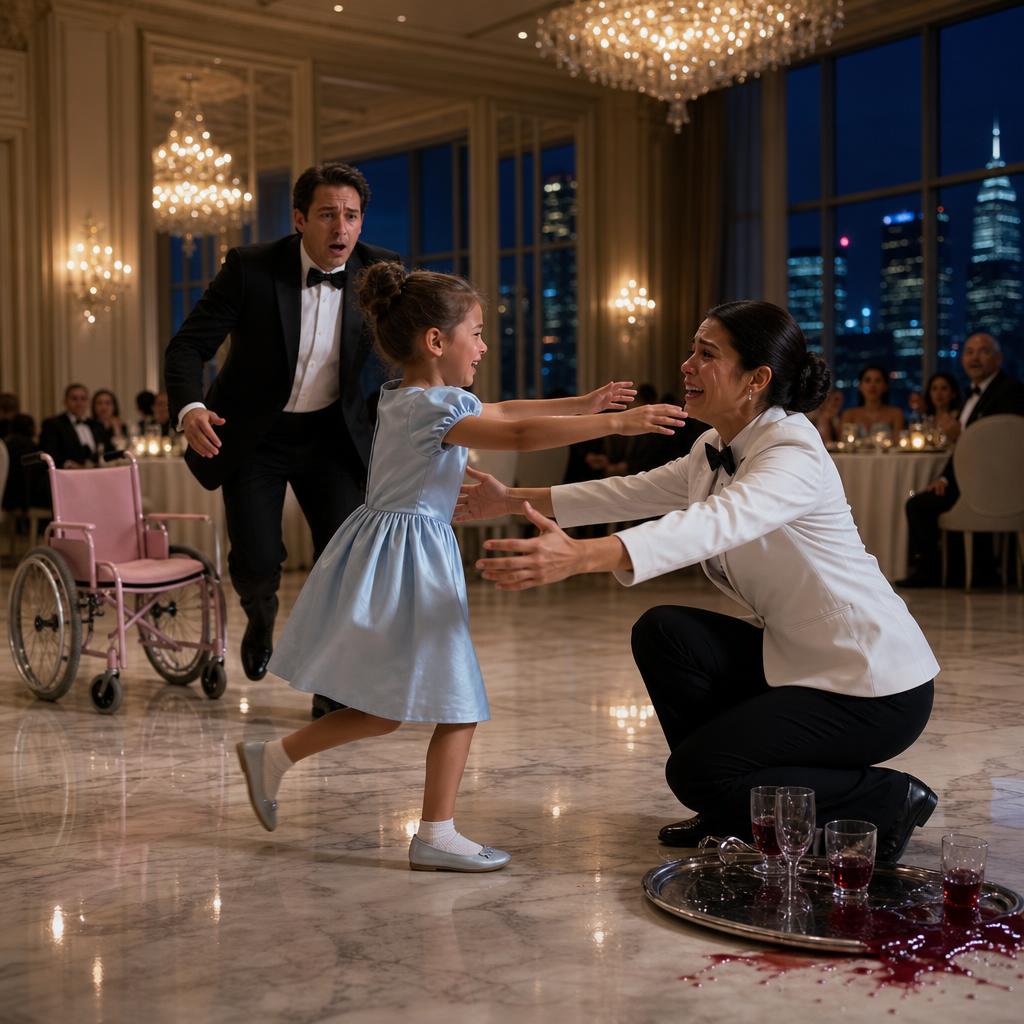
My daughter had been using a wheelchair for months when she stood up in the middle of a ballroom.
For a second, I honestly thought I was imagining it.
Lily was eight years old.
She wore a pale blue satin dress that night, the kind with small sleeves and a bow at the back.
Her pink wheelchair was beside me.
One moment her hand was resting against the wheel.
The next, she leaned forward, planted both feet on the polished floor, and pushed herself upright.
“Lily?”
She did not answer.
Her eyes were fixed on someone across the room.
Then she took a step.
I forgot how to breathe.
Another step.
Then another.
She was not holding the chair.
She was not holding me.
She was standing on her own.
I reached one hand toward her.
“Wait.”
That word had become automatic.
Wait.
Be careful.
Not yet.
But Lily kept moving.
She walked faster.
Then, unbelievably, she ran.
People around us turned to stare.
At the far side of the ballroom, a woman in a white server jacket froze with a silver tray in her hands.
Maria Santos.
The woman I had fired three weeks earlier.
The moment Maria realized Lily was running toward her, her expression changed completely.
The tray slipped.
Glasses struck the marble.
Dark red punch spread across the floor.
Maria barely noticed.
She dropped to her knees and opened her arms.
Lily crashed into her.
They held each other like people who had been separated for years instead of weeks.
I stood beside an empty wheelchair and felt the room tilt.
For months, I had imagined the first time Lily would walk independently.
I imagined a rehabilitation room.
A therapist beside her.
Parallel bars.
Maybe me standing a few feet away with my arms open.
I never imagined she would run across a ballroom toward someone else.
I never imagined that person would be Maria.
Lily’s injury happened the previous winter.
It was not the kind of injury that gave us one clean answer about recovery.
Doctors talked about healing.
Strength.
Pain.
Balance.
Confidence.
Progress could be fast for a week and then disappear for another.
The wheelchair gave Lily freedom during that uncertain period.
She could go to school events.
She could move through large spaces without exhausting herself.
She could participate in life while her body recovered.
At first, I loved that chair because it gave something back to her.
Then I became afraid of everything beyond it.
Lily had always been fearless.
Before the injury, she climbed playground structures adults thought were too high.
She ran down stairs instead of walking.
She believed bruises were simply proof that a day had been interesting.
After the injury, that fearlessness frightened me.
She wanted to stand before I trusted her legs.
She wanted to practice longer than I thought was reasonable.
She hated asking for help.
I became the voice saying no.
Maria became the voice saying, “Let’s see what the plan says.”
Maria had been working with our family for almost two years.
She was not a doctor.
She never pretended to be one.
She helped with ordinary life.
Meals.
School pickup.
Appointments.
Getting Lily dressed on difficult mornings.
During rehabilitation, Maria learned the exercises the therapists gave us.
She wrote them down.
She asked questions.
She never improvised complicated medical treatment.
What she did differently was emotional.
When Lily became frustrated, I rushed to protect her from the frustration.
Maria stayed with her inside it.
If Lily failed to stand on the first attempt, Maria would say, “Okay. What did that teach us?”
If Lily became angry, Maria did not tell her to calm down.
She said, “Be angry for a minute. Then decide what you want to do next.”
I thought that was helpful.
Until fear got involved.
One afternoon I came home early.
Lily was in the living room.
Maria stood beside her.
The wheelchair was several feet away.
Lily was sweating.
Her legs were shaking.
She looked exhausted.
“What is happening?”
Maria turned.
“She wanted to practice the standing exercise.”
“Without the therapist?”
“It is part of the home plan.”
Lily immediately said, “Dad, look.”
She let go of the edge of the table.
She stood for less than two seconds.
Then her knee bent.
Maria caught her under the arms before she hit the floor.
My heart stopped.
I saw nothing except the fall that almost happened.
“What were you thinking?”
Maria looked surprised.
“We were following the exercise plan.”
“She almost fell.”
“She was supported.”
“She was exhausted.”
Lily said my name.
I barely heard her.
I had spent months living with images I never told her about.
Another accident.
Another emergency room.
Another doctor explaining that recovery had gone backward.
Fear makes imagination cruel.
Maria remained calm.
“Daniel, she needs challenge and safety. Both.”
I heard criticism.
Maybe she meant none.
“She is my daughter.”
“I know.”
“You do not decide how far she pushes.”
“I didn’t. Lily asked to practice what she had already been assigned.”
I told Maria we were done for the day.
The argument should have ended there.
It did not.
Over the next week, every small disagreement felt larger.
Lily wanted to stand at the kitchen counter.
I said no.
Maria said the therapist had encouraged normal supported activities.
I heard opposition.
Lily wanted to take several steps between the sofa and chair.
I said wait.
Maria said she could stand beside her.
I heard pressure.
Finally, I told Maria I needed someone who would respect my limits.
She looked at me for a long time.
Then she said, “Are they Lily’s limits or yours?”
That sentence made me furious because part of me knew the answer.
I dismissed her.
Lily cried for two days.
I told myself children became attached to caregivers.
I told myself she would adjust.
I told myself I had protected her.
What I did not know was that before Maria left, Lily had already taken seven independent steps.
Seven.
The number would later feel enormous.
At the time, my daughter hid it from me.
Why?
Because she thought I would make her stop.
The ballroom event came three weeks later.
It was a formal charity dinner connected to my company.
I almost left Lily with my sister.
Lily insisted on coming.
She loved dressing up.
She chose the blue dress.
She asked for her hair in a bun.
She even decorated the spokes of the pink wheelchair with small ribbon ties.
When we arrived, she seemed quiet.
I assumed she was tired.
I did not know Maria had taken temporary banquet work at the hotel.
I did not know Lily had seen her across the room before I did.
Maria was carrying a tray.
Lily stared.
Then she stood.
By the time I understood what was happening, she had crossed half the room.
When Maria caught her, I rushed over.
“How long has she been able to do this?”
My voice sounded harsher than I intended.
Maria looked at Lily.
That was when I realized there was something I did not know.
I crouched.
“Why didn’t you tell me?”
Lily’s answer was immediate.
“Because you get scared.”
I wanted to deny it.
I could not.
“Scared of what?”
“When I stand.”
I looked at her.
She looked back.
Children do not always give adults sophisticated explanations.
Sometimes they give accurate ones.
I was scared.
Lily continued.
“When I wobble, you say sit down.”
My throat tightened.
“Because I don’t want you hurt.”
“I know.”
That made it worse.
She knew I loved her.
She also knew my love had become a limit.
Maria said nothing.
I looked at her.
“Did you tell her to hide this?”
“No.”
Lily answered too.
“No.”
“Did you make her practice?”
Maria shook her head.
“Never.”
Lily put one hand against her chest.
“She said I could stop whenever I wanted.”
I asked what Maria had actually done.
Lily told me.
Standing practice at the sofa.
Weight shifting.
A few steps between stable surfaces.
All exercises already on her rehabilitation plan.
No secret miracle treatment.
No reckless challenge.
No promise that she would walk normally by a certain date.
Maria simply stayed calm when Lily struggled.
Then Lily said the sentence that changed everything.
“She was the only one who let me believe falling didn’t mean failing.”
I looked at Maria.
She was crying.
So was I.
The ballroom continued around us.
Guests pretended not to stare.
A staff member quietly began cleaning the spilled punch.
The silver tray sat on the floor.
The pink wheelchair remained across the room.
All of it looked strangely ordinary beside the realization happening inside me.
I had confused preventing fear with creating safety.
They are not the same.
Safety gives someone room to try.
Fear removes every possible risk.
And if you remove every possible risk from a child’s life, you can also remove movement.
I apologized to Maria that night.
Not because I suddenly believed every decision she had made was perfect.
Because I understood I had judged her through panic instead of facts.
“I thought you were pushing her.”
Maria wiped her face.
“I was trying not to.”
“What does that mean?”
“She pushed herself.”
I looked at Lily.
Maria continued.
“My job was mostly to keep her from believing one bad attempt meant she should never try again.”
I sat beside Lily.
“You should have told me you could walk.”
Her expression changed.
For a second she looked guilty.
I regretted the sentence immediately.
“No,” I corrected. “I should have made it safe for you to tell me.”
Lily leaned against me.
That was the first moment I felt like I was finally helping instead of controlling.
The next day, I called her rehabilitation team.
Not to demand proof.
Not to ask why nobody told me about seven steps.
To ask what support actually looked like.
The therapist explained something I should have understood earlier.
Recovery required calibrated risk.
Not reckless risk.
Not zero risk.
Calibrated risk.
Lily needed supervision appropriate to her stage.
She needed rest.
She needed honest pain monitoring.
She also needed opportunities to attempt things.
My fear had taken the word “supervision” and translated it into “prevention.”
We changed the plan at home.
The wheelchair stayed.
That is important.
The story was never that standing made the wheelchair a failure.
Some days Lily still needed it.
Long distances exhausted her.
Crowded places were difficult.
Pain could appear unexpectedly.
The chair remained a tool.
But it stopped being a rule.
If Lily wanted to practice approved movements, we practiced.
If she needed the chair, she used it.
If she fell safely, we did not treat the fall like catastrophe.
We asked what happened.
We adjusted.
We tried again when she was ready.
Maria did not immediately return to work for us.
I asked.
She said no.
At first, that surprised me.
Then she explained.
“You fired me because we stopped trusting each other. That does not disappear because Lily crossed a ballroom.”
She was right.
So we rebuilt trust separately from employment.
Maria visited Lily.
We all met with the therapist together.
We clarified what Maria could help with and what required professional supervision.
Eventually she returned part-time.
But this time, the boundaries were explicit.
Not mine alone.
Not Maria’s.
Not Lily’s.
Shared.
Months later, we returned to the same hotel for a smaller event.
Lily used her wheelchair through the lobby because the distance from parking was long.
When we reached the ballroom entrance, she looked at me.
“Can I walk from here?”
My first instinct still appeared.
What if—
I felt it.
I did not obey it automatically.
I asked, “How are your legs?”
“Good.”
“Pain?”
“No.”
“Tired?”
“A little.”
I looked at the distance.
Then I smiled.
“Want me beside you?”
She nodded.
I walked next to her.
Not holding her.
Not pulling her.
Not telling her to slow down every two seconds.
Just close enough.
Halfway across the room, she stumbled.
My hands moved instinctively.
Lily caught herself first.
She looked at me.
I froze.
Then she smiled.
“I’m okay.”
I smiled back.
“I know.”
That was progress too.
Not only hers.
Mine.
Maria was working another event that night.
When Lily saw her, she did not run.
She walked carefully across the room.
Maria opened her arms.
They hugged.
No tray dropped this time.
No punch spilled.
No crowd turned.
It was quieter.
Better.
Later, Lily asked me if I remembered the first ballroom night.
“I remember everything.”
“Were you mad at Maria?”
“Yes.”
“Were you mad at me?”
“No.”
She thought about it.
“You looked mad.”
“I was scared.”
She nodded as if that made sense.
Then she said, “You don’t look as scared now.”
I looked at my daughter.
That may have been the best thing anyone ever said about my parenting.
I had believed protecting Lily meant standing between her and every possible fall.
I was wrong.
Sometimes protection means standing close enough to help if she needs you.
And far enough away to let her discover she may not.
The pink wheelchair was never the enemy.
Maria was never the miracle.
And Lily was never broken.
What changed was simple.
I stopped treating every wobble like the end of the world.
She stopped hiding her strength from me.
And together, we learned the difference between holding someone back and standing beside them.